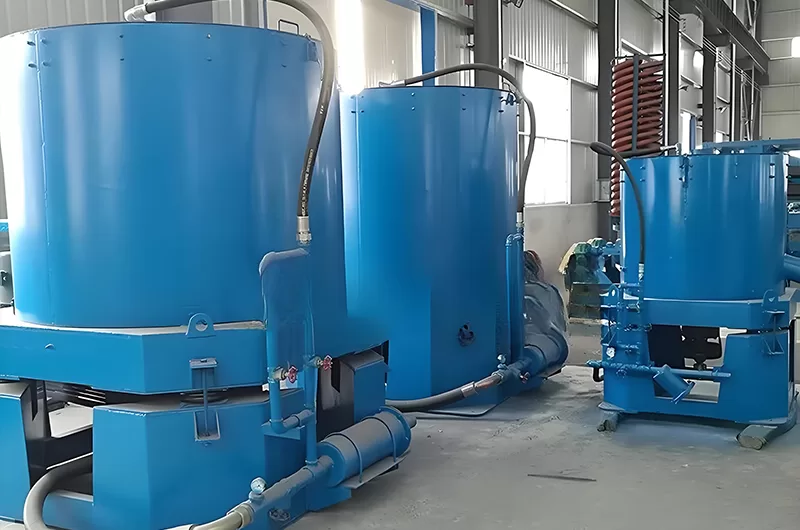
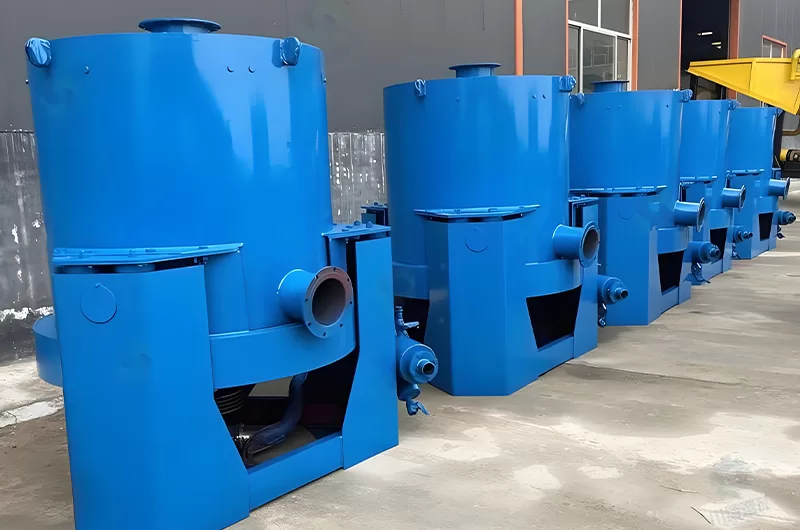
Shaking table is also called shaker table, which is the commonly used gravity ore dressing equipment. Its separation efficiency is greater than the general gravity separation equipment.
Capacity :0-60 T/H
Feeding size: 0-6mm
Processible Material:Alluvial gold, rock gold after grinding, and other precious metals
Type:Vertical auto discharging centrifuge and vertical type manual discharging centrifuge
Centrifugal gold concentrator utilizes the principles of a centrifuge to enhance the gravitational force experienced by feed particles to effect separation based on particle density. It can be used not only for alluvial gold mining, but also for recover the natural gold from hard rocks, to replace amalgamation,and recover gold from the tailing.applications shows that the recovery can be as high as 99%, and the concentrating ratio is up to1000 times.In recovering the natural gold in lode ore with size -0.074mm, the gold recovery is up to 98%.
What Is a Centrifugal Concentrator?
A Centrifugal Concentrator is a high-efficiency gravity separation device that utilizes centrifugal force to separate heavy minerals from light particles. Centrifugal separator is engineered specifically to recover free, metallic gold, platinum, and silver. Unlike traditional gravity devices that rely on standard 1G gravitational pull (like sluice boxes or shaking tables), a Centrifugal Concentrator generates a force field ranging from 60G to 100G. This intensified gravity allows for the precise separation of very fine particles that would otherwise wash away with the waste rock.
The equipment is particularly famous for its ability to recover “fine gold”—particles smaller than 50 microns. In a typical processing circuit, this machine acts as a scavenger or a primary concentrator, often achieving recovery rates as high as 98-99% for free gold. It effectively processes feed materials with a particle size range from 0 to 6mm. For ZONEDING, this technology represents the bridge between rough separation and high-purity refinement.
What are Different Types of Centrifugal Concentrator?
While the core principle remains the same, Centrifugal Concentrators are categorized based on their discharge method and operational continuity. Understanding the difference is vital for selecting the right model for a specific mine site.
1. Manual Discharge Concentrator
This is the most common type for small to medium-scale placer mining. It operates in batches. The machine runs for a set period (usually 1 to 4 hours) depending on the grade of the ore. Once the concentrate cone is full of heavy minerals, the machine must be stopped. The operator then manually washes the concentrate out or opens a valve to flush it.
Best for: Alluvial/Placer gold mining, cleanup stages, and operations with lower budgets.
Designed for larger operations and hard rock mining circuits, this type features an automated valve system. It allows for the flushing of concentrates without completely shutting down the main processing flow or requiring manual labor. The cycle time is controlled by a timer or PLC system, discharging concentrates periodically (e.g., every 30 to 60 minutes) in seconds.
Best for: Hard rock grinding circuits (ball mill discharge), large-scale plants, recovery of gold from tailings.
What are Advantages and Benefits of Centrifugal Concentrator?
Why are mining companies replacing older gravity methods with Gold Centrifugal Concentrators? The shift is driven by efficiency, environmental concerns, and profitability.
High Recovery of Fine Gold:The primary advantage is the recovery of fine and ultra-fine gold (down to -300 mesh). Traditional sluices lose gold that is flat or flaky. The high G-force of a gravity concentrator pins these light, flaky gold particles against the wall, preventing them from washing away.
Environmentally Friendly:This is a “Green Mining” technology. It requires only water and electricity. It completely eliminates the need for mercury or cyanide during the primary concentration stage. This makes it safer for operators and compliant with strict environmental regulations.
High Concentration Ratio:The machine reduces the volume of material significantly. It can achieve a concentration ratio of up to 1000:1. This means a massive amount of raw ore is reduced to a very small, manageable amount of high-grade concentrate, simplifying the final cleanup stage.
Space and Energy Efficiency:Compared to a shaking table or a spiral chute bank of the same capacity, a centrifugal concentrator occupies a fraction of the floor space. ZONEDING’s designs are compact and mobile-friendly. Additionally, the energy consumption per ton of ore processed is relatively low.
What are Applications of Centrifugal Concentrator?
The versatility of the Centrifugal Concentrator allows it to be integrated into various stages of a mineral processing flowsheet.
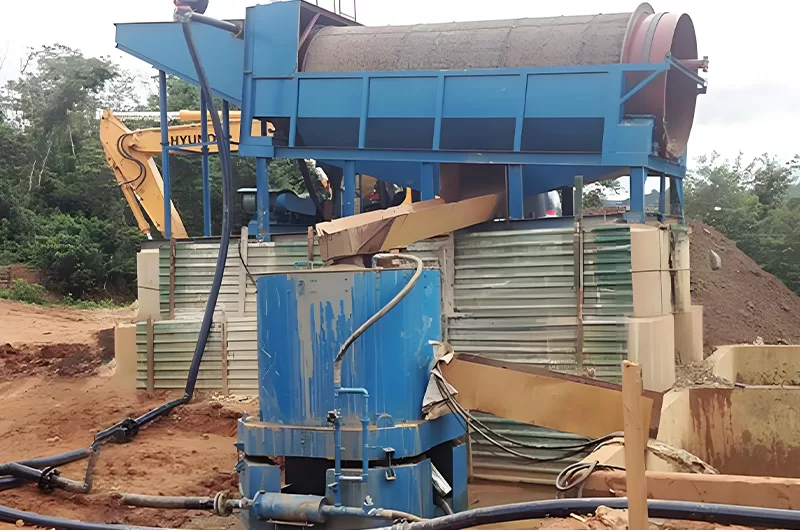
Placer Gold Mining (Alluvial):In river mining or alluvial deposits, the concentrator serves as the roughing equipment. After the material passes through a trommel screen to remove large rocks, the slurry is fed into the concentrator. It is exceptionally effective at recovering “flour gold” that traditional sluice boxes miss.
Hard Rock Gold Mining (Lode):In hard rock plants, the concentrator is typically installed in the grinding circuit. It is placed at the discharge of the Ball Mill or within the cyclone underflow. Its job is to recover the “nugget effect” gold early in the process. Recovering gold gravity-recoverable gold (GRG) early prevents it from being over-ground and smeared, and reduces the load on the cyanide leaching circuit.
Tailings Recovery:Many old mine tailings still contain significant amounts of fine gold that older technology could not catch. Processing these tailings through a Centrifugal Concentrator is a cost-effective way to recover lost value from waste dumps.
Other Heavy Minerals:While famous for gold, this machine is also used for recovering other heavy minerals such as:
Platinum group metals (PGM)
Tungsten
Tin
Tantalum
Niobium
What is the Structure of Centrifugal Concentrator?
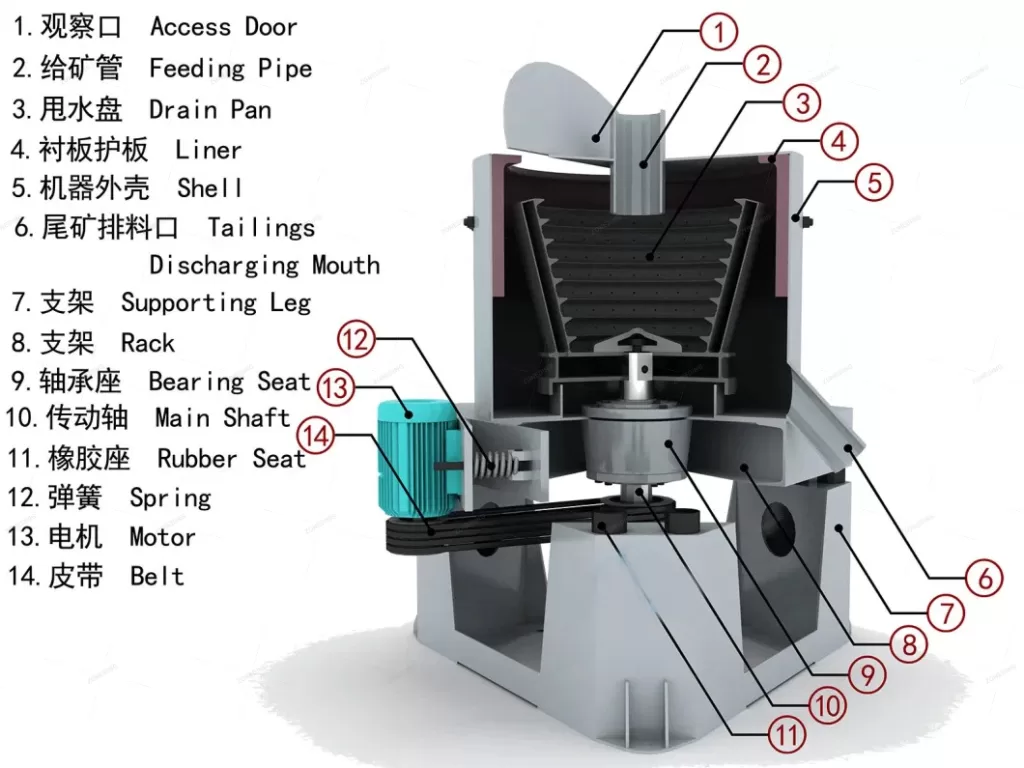
A robust structure ensures the machine can withstand high-speed rotation and abrasive slurries. The Centrifugal Concentrator is composed of several key assemblies.
1. The Rotating Bowl (Cone):This is the heart of the machine. It is a double-walled cone made of stainless steel or durable polyurethane. The inner wall has a series of riffles (rings). Between the inner and outer walls is a water jacket.
2. Fluidization Water System:The inner wall of the bowl has multiple tiny holes. Pressurized water is injected through these holes. This water is crucial for the separation process (explained in the working principle).
3. The Drive System:A powerful electric motor drives the central shaft via a belt pulley, causing the bowl to spin at high speeds (typically 400-800 RPM depending on size).
4. The Frame and Housing:A heavy-duty steel frame supports the motor and the spinning bowl. The housing collects the tailings (waste) and directs them to the outlet, while a dedicated port is used for concentrate discharge.
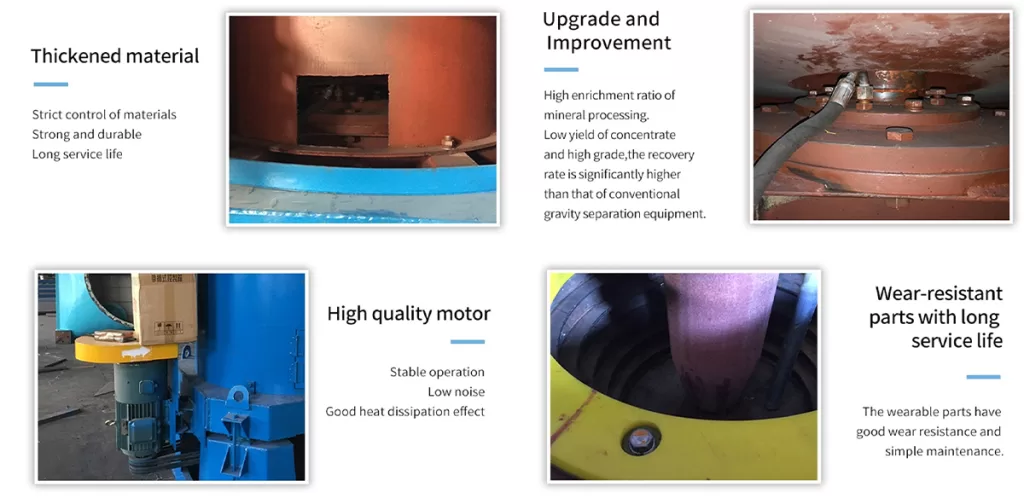
ZONEDING ensures that the inner cone is lined with wear-resistant Polyurethane (PU). This significantly extends the lifespan of the bowl compared to standard steel liners.
Gold Centrifugal Concentrator Features
High concentrating ratio and high recovery
Total process automation, steady recovery performance
Low energy consumptions
Environmentally friendly(requires no chemical additives or reagents)
Low water and electricity requirements
Low production costs, durable wear parts, minimal maintenances requirements
Compact design requiring less space, easy merged into the existing mining processing
Quick payback on investment, typically lass than half year
Rugged design and a high degree of quality manufacturing ensures that every Concentrator will provide many years of reliable,trouble-free operation in even the most severe operating environments.
How Does the Centrifugal Concentrator Work?
The operation of a mineral processing centrifuge combines centrifugal force with a process called fluidization.
Step 1: Acceleration:The slurry (mixture of ore and water) is introduced through a central feed pipe. As it hits the bottom of the spinning bowl, it is thrown outward by centrifugal force. The material pushes up the sides of the bowl.
Step 2: Bed Formation:The solids settle into the riffles (grooves) on the inner wall of the bowl. The immense G-force (60G+) pins the heaviest particles (gold) deep into these riffles.
Step 3: Fluidization:This is the secret to high performance. Water is injected from the outside of the bowl through the tiny holes in the riffles. This incoming water pressure pushes against the centrifugal force. It keeps the bed of material “fluid” or “active.”
Step 4: Separation:The fluidization water is strong enough to push out light particles (sand, rock) but not strong enough to push out the heavy gold. The light particles are washed over the top of the riffles and ejected as tailings. The heavy gold replaces the lighter material in the riffles.
Step 5: Concentrate Cycle:Eventually, the riffles become full of pure gold concentrate. The feed is stopped, the bowl slows down, and the high-grade concentrate is flushed out into a secure container.
Gold Centrifugal Concentrator working principle
Centrifugal Concentrator use the principles of a centrifuge to enhance the gravitational force experienced by feed particles to effect separation based on particle density. The key component is cone shaped concentrate bowl. Feed material is fed as a slurry toward the center of the bowl from above. The feed slurry contacts the base plate of the vessel and due to its rotation, is thrust outward. The outer extremites of the concentrate bowl house a series of ribs and between each pair of ribs is a groove. During operation the lighter materials flows upward over the grooves and heavy mineral particles become trapped within them. Pressurized water is injected through a series of tangential water inlets along the perimeter of each groove to maintain a fluidized bed of particles in which heavy mineral particles can be efficiently concentrated.
Main Parts of Centrifugal Concentrator
Feeding, rotor, groove, motor, backwash water, PU lining plate, bearing, frame, tailings and concentrate discharge, etc.
What is the Price of a Centrifugal Concentrator?
The price of a Centrifugal Concentrator varies widely based on capacity, automation, and origin. Mining operators need to balance budget with recovery goals.
Capacity Factor: A small lab-scale unit (STLB20) capable of processing 2-3 tons per hour will cost significantly less than an industrial STLB100 model capable of handling 80-100 tons per hour.
Automation Factor: Manual discharge models are the most affordable entry point. Fully automatic, continuous discharge models require complex PLC control panels and pneumatic valves, increasing the cost.
Material Quality: Machines using high-grade Polyurethane liners and Siemens motors will command a higher price but offer lower long-term maintenance costs.
Generally, small-scale units range from a few thousand dollars, while large industrial automated units can reach tens of thousands. As a manufacturer, ZONEDING provides factory direct prices, eliminating dealer markups. For a precise quote based on tonnage per hour, it is best to contact the sales engineering team directly.
How to Choose the Suitable Centrifugal Concentrator?
Selecting the right Gold Recovery Equipment requires an analysis of the mining conditions.
1. Determine the Processing Capacity:Calculate the tons per hour (TPH) needed. Choosing a machine that is too small creates a bottleneck. Choosing one that is too big wastes energy.
2. Analyze Particle Size:These concentrators work best on material between 0mm and 6mm. If the feed contains larger rocks, a screening plant (like a Trommel) must be installed before the concentrator.
3. Water Availability:The fluidization process requires a steady supply of clean water. The water pressure and volume must match the machine’s specifications. If water is scarce, a water recycling system must be planned.
4. Ore Grade:For high-grade ore, an automatic discharge model is preferred to prevent the riffles from filling up too quickly (which leads to gold loss). For lower-grade placer deposits, a manual discharge unit is usually sufficient.
What are Features of Centrifugal Concentrator from ZONEDING?
ZONEDING has optimized the design of the STLB series concentrator based on feedback from mines in over 50 countries.
High Recovery Rate: Proven capabilities to recover gold particles as small as 37 microns, with recovery rates reaching 98% for free gold.
Automatic Systems: ZONEDING offers fully automated discharge systems that reduce labor intensity and improve security (preventing theft of concentrate).
Wear Resistance: Key components, specifically the inner cone, are lined with premium Polyurethane. This resists abrasion from sand and extends service life by 3-5 times compared to steel.
Stable Operation: Equipped with soft-start motors/inverters to ensure smooth startup and variable speed control to adjust G-force based on material type.
Water Efficiency: Optimized fluidization holes reduce fresh water consumption while maintaining bed activity.
Technical Parameter of Gold Centrifugal Concentrator
Model
BC-19
BC-30
BC-60
BC-80
BC-100
Capacity(t/h)
0.25-0.3
2-3
10-15
35-40
80-120
Feeding size(mm)
0-3
0-4
0-6
0-6
0-6
Feeding density(%)
0-50
Fludization water(m³/h)
2-3
3-5
7-10
30-36
50-60
Concentrate capacity(kg/time)
2-3
10-20
30-40
60-70
70-80
Power (kw)
0.75
1.5
5.5
11
18.5
Overall Size (mm)
790*785*790
1180*1140*1250
1970*1670*1750
2300*1800*2200
2500*2000*2400
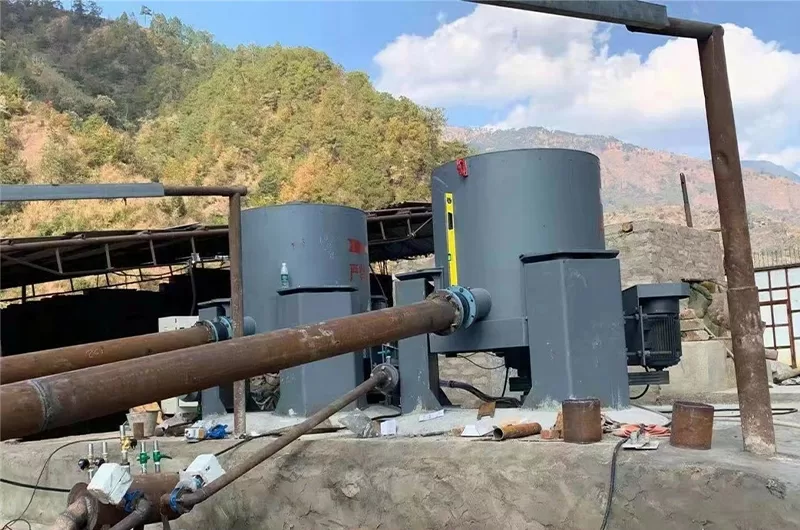
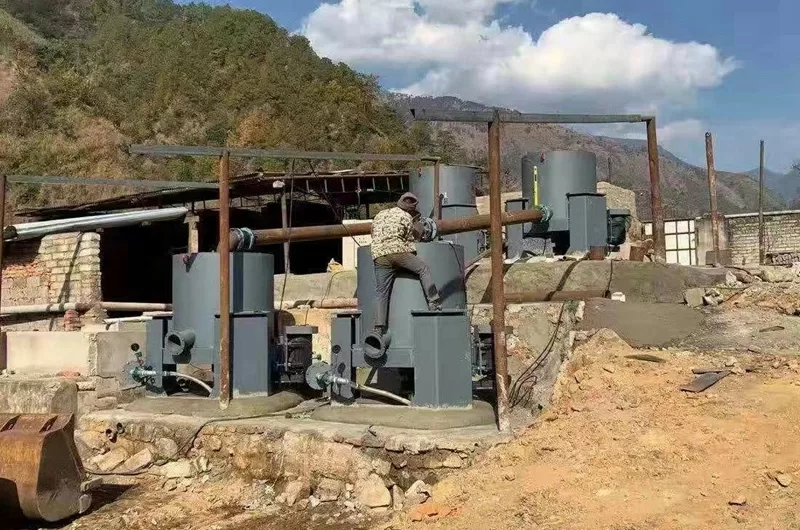
Customer Cases
What is a Centrifugal Concentrator/Mining Centrifuge?
A Centrifugal Concentrator / Mining Centrifuge is a machine that uses centrifugal force to separate materials of different densities, commonly used in mineral processing.
What minerals can be processed with a Mining Centrifuge?
Mining Centrifuges effectively process gold, silver, platinum, tantalum, and other valuable heavy minerals from ore and tailings.
What are the benefits of using a Centrifugal Concentrator in mining?
Centrifugal Concentrators provide high recovery rates, low operating costs, and environmentally friendly mineral processing compared to traditional methods.
How does a Mining Centrifuge work?
A Mining Centrifuge uses a rotating bowl or cone to create centrifugal force, separating heavier minerals from lighter materials based on density.
What factors should I consider when choosing a Mining Centrifuge?
Consider feed rate, particle size, recovery rate, capacity, and maintenance requirements when selecting a Mining Centrifuge for your operation.
Contact us to review our catalog and get more information about our products.
 Zoneding Mining