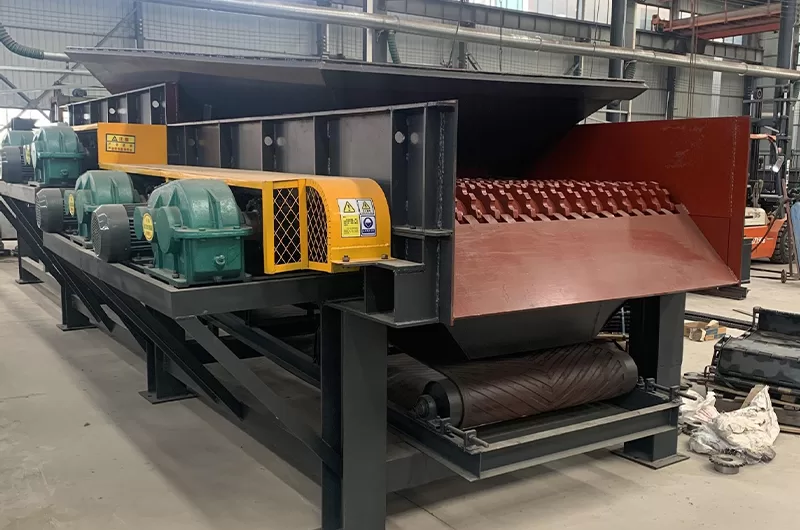
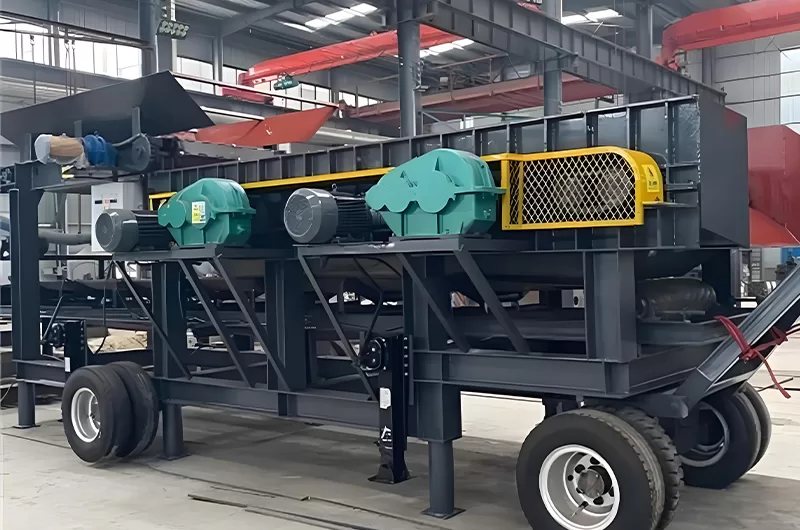
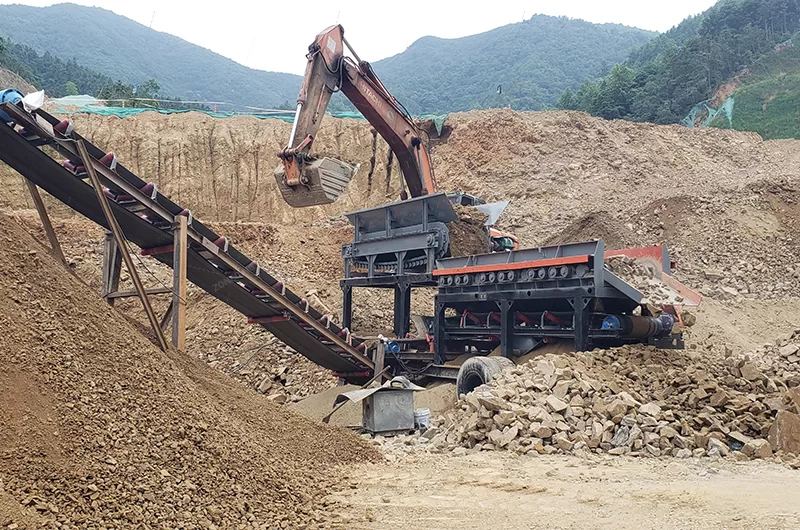
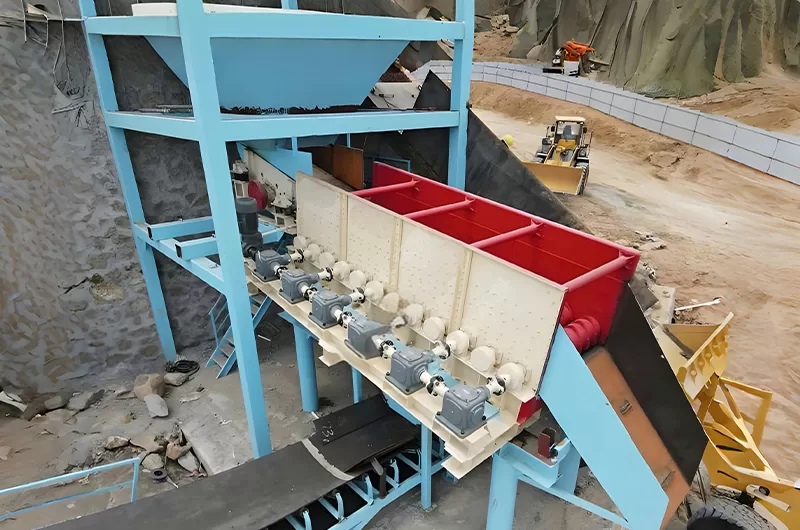
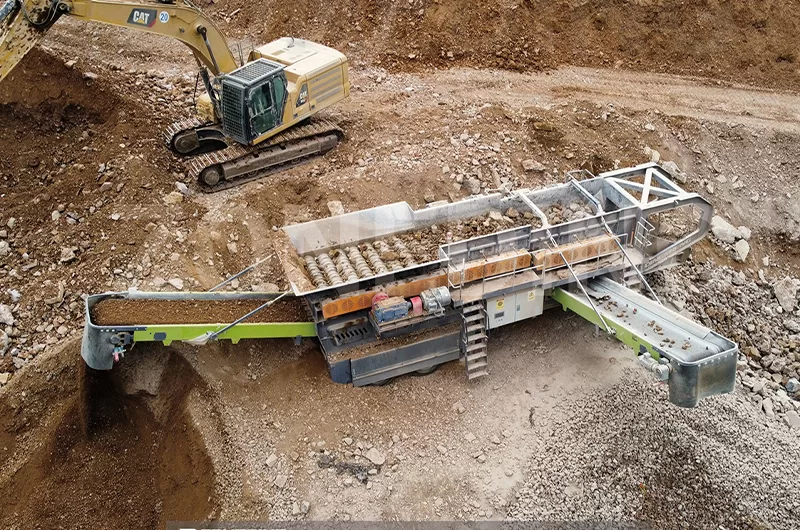
The Mud And Stone Separator like stones, waste, coal, and wet/sticky substances based on size, shape, and proportion, easing downstream load. It offers adjustable screening size and auto-adjusting speed, supporting resource conservation and recycling.
Feed Size:200-1500mm
Motor Power:5.5-280KW
Processing capacity:50-1500t/h
Application:Mud rock/sand stone/ore, various domestic wastes, various commercial/industrial wastes, coal, decoration/construction wastes, viscous wet materials, etc.
Debris separator, also known as separating screen, roller screen, butterfly screen, etc. Due to the large mud content of the stone excavated from some sand and stone yards, the use of the stone will cause problems such as crusher blockage, low production capacity, poor sand and stone quality, and the labor cost is too high and the efficiency is low. The mud rock separator produced by our company can not only solve the shortage of sand and stone resources, but also can be quickly separated without water. It can not only replace the traditional feeder and shale shaker, but also open up new vitality for the sand industry.
What is the Mud and Stone Separator?
The Mud and Stone Separator is a heavy-duty pre-screening machine composed of multiple rotating shafts equipped with irregular discs, designed to separate soil and fines from coarse rock.
Unlike a standard vibrating screen which uses a woven mesh (and easily clogs with mud), this machine uses a series of axles. Imagine a conveyor belt, but instead of a rubber belt, the “floor” is made of spinning steel rollers.
The Motion: The discs are shaped like rounded triangles or cams. As the shafts rotate, they lift and drop the material violently.
The Result: This “wobbling” action shakes the heavy clay loose. The fines fall through the gaps between the shafts, while the clean, large rocks carry on over the top to the crusher.
Why Do We Need the Mud and Stone Separators?
You need this machine if your raw material is dirty. Here is the economic logic I share with my clients:
1. Preventing Crusher Blockages:If you feed mud into a Jaw Crusher or Impact Crusher, it packs into the corrugations of the liners. This “packing” reduces the crushing chamber volume. Eventually, the crusher stalls. The Separator removes the mud first.
2. Increasing Production Capacity:Why crush dirt? If your raw feed is 30% soil and 70% rock, and you put it all through the crusher, your crusher is wasting 30% of its energy on material that is already small enough. By removing that 30% beforehand, you immediately increase your rock output by nearly 40-50%.
3. Reducing Wear:Soil often contains silica sand, which is extremely abrasive. By bypassing this abrasive material around the crusher, your costly excessive wear on jaw plates and blow bars is significantly reduced.
What Are Applications and Applicable Materials of Mud and Stone Separator Machine?
Over the last 30 years at ZONEDING, I have deployed these units in highly diverse environments. It is not just for quarries.
1. Quarry Overburden (Stripping):Before you get to the good granite or limestone, you have to strip the top layer. This mix of soil, roots, and weathered rock is perfect for this machine. You can recover the rock and sell the soil as fill.
2. Landfill and C&D Waste:In Construction and Demolition (C&D) recycling, the feed is full of bricks, concrete, wood, and plastic. The Mud and Stone Separator acts as a “Debris Separator,” shaking out the fine dust and dirt so the picker station encourages cleaner sorting.
3. River Cleaning / Dredging:Wet river run material is sticky. A vibrating screen would “blind” (clog) in minutes. The rolling action of our separator is self-cleaning, making it ideal for wet river stones.
4. Coal and Mineral Processing:Separating coal from gangue or preparing sticky bauxite ore.
Application of Mud and Stone Separator
It is applicable to the separation conditions of various stones such as mud rock/sand stone/ore, various domestic wastes, various commercial/industrial wastes, coal, decoration/construction wastes, viscous wet materials, etc.
What is the Structure of Mud and Stone Separator?
The beauty of this machine is its robust simplicity.
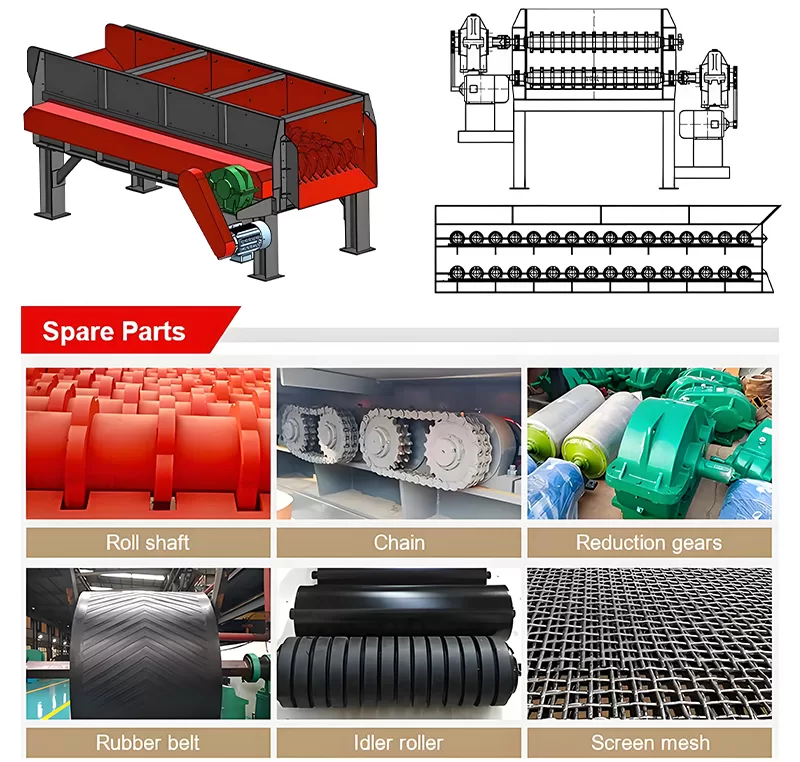
1. The Box Frame:A heavy welded steel structure that holds everything together. We use reinforced steel because the vibration and impact forces are high.
2. The Shaft Assembly (The Heart):Multiple solid steel shafts run across the width of the machine.
ZONEDING Spec: We use thicker shafts than the market average to prevent bending when a massive 1-meter boulder is dropped on them.
3. The Discs / Cams:These are wear-resistant plates welded or bolted onto the shafts. their shape is irregular (not a perfect circle). This irregularity creates the “wobble” or jumping motion.
4. The Drive System:Each shaft (or groups of shafts) is driven by a chain and sprocket system connected to an electric motor and reducer.
How Does the Mud and Stone Separators Work?
Phase 1: Feeding:The raw material is dumped onto the receiving end of the separator, usually via a Vibrating Feeder or direct dump truck.
Phase 2: Agitation and Dispersion:The shafts rotate in the same direction, pushing the material forward. Because the discs are irregular, the material doesn’t just slide; it jumps. This constant tumbling breaks apart clumps of clay stuck to the stones.
Phase 3: Separation:Gravity takes over. The gaps between the shafts and discs are set to a specific size (e.g., 50mm). Anything smaller than 50mm (soil, chips, dust) falls through the gaps onto a discharge belt below.
Phase 4: Discharge:The clean, large rocks (Oversize) “surf” over the rolling discs until they drop off the end, directly into the crusher intake.
working principle of Mud and Stone Separator
It is mainly composed of a box, a lining plate, a disc, a transmission shaft, a speed regulating motor, a chain sprocket, and other structures.The material is put into the sieve box from the feeding port. The sprocket drives the roller to turn over, and the material is driven forward by the roller. The soil leaks out from the gap, and falls onto the belt conveyor to be discharged. The bulk material above the roller moves to the end and is discharged, completing the debris separation. The clearance between each shaft can be customized according to actual needs.
Independent Drive: Each screen shaft is driven separately by its own motor reducer.
Boiler Coal Application: Suitable for pre-screening coal particle size in boiler fuel and coal preparation systems.
Multi-Angle Shafts: Shafts are angled (e.g., 15° inlet, 5° outlet) to ensure uniform material distribution.
Features of Mud and Stone Separator
The screening accuracy is high, the processing capacity is 4 times of the traditional roller screen with the same volume, and the screening efficiency is 1.5 times of the roller screen.
The production capacity can be as high as 1500t/h.
The frequency conversion drive control mode is adopted, with small power, low energy consumption, high safety and stability.
Adjustable processing capacity, small volume .
It does not take up space and is easy to move.
The material can be discharged automatically and operated continuously. It can be used for conveying, separating, screening and other functions under different industrial mines to achieve multiple purposes.
Specially made chain wheel, chain linkage, tension chain design, high operation stability, low noise, few vulnerable parts, and easy replacement.
Modular assembly, which can be lengthened or shortened according to material conditions, facilitates maintenance and structural adjustment.
It has high operation stability and screening, and is applicable to the separation of all kinds of domestic garbage, all kinds of commercial and industrial garbage, debris, sandstone, ore and other stones, decoration, construction waste, and viscous wet materials.
What is the Price of Mud and Stone Separators?
The price varies significantly based on width, length, and capacity.
Typical Price Range:
Small (600mm width, 6 shafts):$12,000 – $18,000 USD. Good for small recycling yards.
Medium (1000mm width, 10 shafts):$25,000 – $35,000 USD. The standard for most quarries (100-200 TPH).
Large (1500mm+ width, Heavy Duty):$40,000 – $70,000+ USD. For massive mining operations processing 500+ TPH.
Cost Factors:
Shaft Material: Standard steel vs. 40Cr alloy steel.
Disc Material: Using high-manganese steel (Mn13) or Hardox for the discs increases the price but doubles the lifespan.
Drive Type: Individual shaft drives (more expensive, better control) vs. single motor chain drive (cheaper).
How To Choose the Right Mud and Stone Separator Machine?
Do not just buy the biggest one. You need to match the machine to your material conditions.
1. Analyze Your Moisture: If your material is basically mud soup, you need a steeper angle and faster rotation speed to prevent sticking.
2. Throughput Requirements: Separators are rated by TPH (Tons Per Hour). If you need 300 TPH, you need a wide machine (at least 1200mm). If you overload a narrow machine, the bed depth gets too thick, and the cleaning efficiency drops because the top layer of rocks never touches the shafts.
3. Separation Size (Gap): What size do you want to remove?
Removing just dirt? Set gap to 20-30mm.
Making road base? Set gap to 80mm.
Note: Decide this early. Changing the gap later requires significant labor (changing discs).
What is the Maintenance Requirements of Mud and Stone Separators?
This machine has many moving parts (bearings), so lubrication is life.
1. Bearing Lubrication:
There is a bearing at both ends of every single shaft. A 10-shaft machine has 20 bearings.
ZONEDING Solution: We often install automatic central lubrication systems. If you do it manually, you must grease them daily. If dirt gets into the bearing, the shaft seizes.
2. Chain Tension:
The drive chains stretch over time. You need to check tension weekly. Loose chains create backlash that damages the sprockets.
3. Disc Wear:
The discs take a beating. Monitor their thickness. Once the “cam” shape wears down to a circle, the agitation stops, and the machine loses efficiency.
What are the Strengths of ZONEDING’s Mud and Stone Separator Machines?
We built our reputation on handling the tough, sticky feeds that other machines failed on.
1. Variable Frequency Drive (VFD) Control: We equip our separators with VFD panels. This allows you to adjust the rotation speed.
Sticky day? Speed it up to throw the mud off.
Dry day? Slow it down to save energy and wear.
2. Modular Shaft Design: In older designs, if a shaft bent, you had to cut the whole machine apart. ZONEDING uses a modular assembly. You can unbolt and lift out a single shaft assembly for repair without dismantling the whole frame.
3. Anti-Clogging Logic: Our control software features an “Auto-Reverse” function. If a rock gets jammed between two shafts and the amperage spikes, the machine automatically reverses for 3 seconds to unjam itself, then resumes forward.
Vibrating Screen vs. Roller Screen: Which is Better for Your Quarry?
Feature
Vibrating Screen (Circular/Linear)
Mud & Stone Separator (Roller Screen)
Accuracy
High (Ex: sizing 19mm vs 22mm)
Low (Rough separation / Scalping)
Moisture Limit
Low (<5% moisture)
High (Can handle very wet/sticky)
Clogging
Blinds easily with mud
Self-cleaning, resist clogging
Space
Requires height
Compact, flat profile
Best For
Final Product Sizing
Initial Feed Cleaning (Scalping)
Is It Possible to Adjust the Separation Gap for Different Material Sizes?
Yes, but it is not a “push button” adjustment.
The gap is determined by the spacing of the discs on the shaft.
Method: To change from 50mm to 80mm, we must stop the machine, remove the shafts, and either replace the spacer sleeves between the discs or rearrange the discs.
Advice: It is labor-intensive. I always advise clients to test their material thoroughly before ordering so we set the factory gap correctly. Do not expect to change this gap weekly.
Electric vs. Hydraulic Drive: Which Power Option Suits Your Site?
Electric Motor Drive:
Pros: High efficiency, lower maintenance, consistent speed.
Use: 90% of fixed quarry plants use this. It connects easily to the grid.
Hydraulic Motor Drive:
Pros: Massive torque at low speeds. Can start efficiently even when fully loaded with heavy rock (electric motors might trip). Compact size.
Use: Ideal for Mobile Crushers (Tracked or Wheeled) where space is tight and hydraulics are available. Also good for extremely heavy-duty scalping.
Technical Parameter of Mud and Stone Separator
Model
Width(dm)
Length(dm)
Number Of Axes
Number Of Motor
Power(KW)
Capacity(t/h)
0806
08
18
6
1
11
54-144
0808
08
24
8
1
15
72-192
0810
08
30
10
1
18.5
90-240
1010
10
30
10
2
11
112-300
1012
10
36
12
2
15
135-360
1014
10
42
14
2
15
158-420
1212
12
36
12
2
18.5
162-432
1214
12
42
14
2
18.5
189-504
1216
12
48
16
2
22
216-576
1318
13
54
18
3
18.5
263-702
1418
14
54
18
3
18.5
283-756
1518
15
54
18
3
22
303-810
1520
15
60
20
4
18.5
337-900
1620
16
60
20
4
18.5
360-960
1820
18
60
20
5
18.5
405-1080
What’s a Mud and Stone Separator for?
It efficiently separates mud and stones for cleaner materials in construction, landscaping, and recycling. Boosts material separation!
What materials can a mud and stone separator process?
Handles gravel, sand, crushed stone, and construction debris. Great for aggregate cleaning and concrete recycling.
How does the Mud and Stone Separator work?
Uses screening, vibration, and water (optional) for size/density-based soil separation and stone cleaning.
why we need a Mud and stone separator?
Reduces labor, increases efficiency, improves material quality, and minimizes waste. Improves aggregate processing!
Contact us to review our catalog and get more information about our products.
 Zoneding Mining