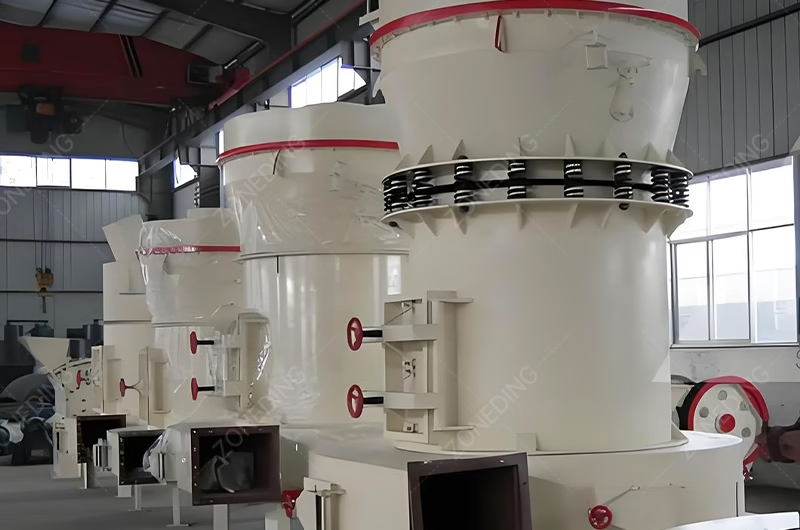
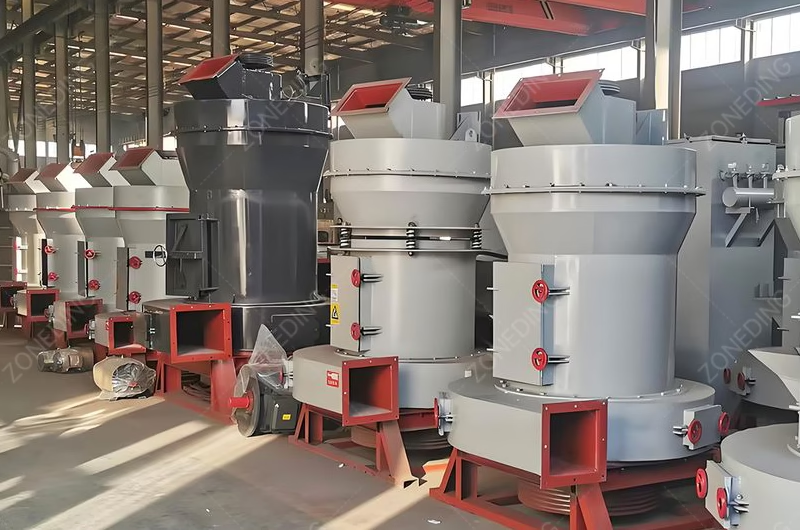
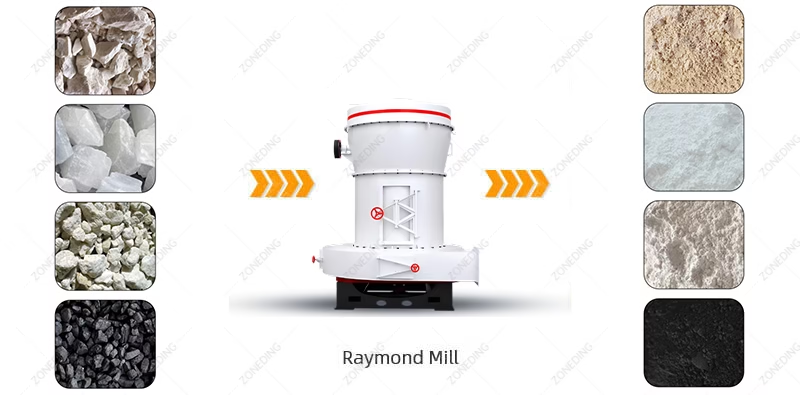
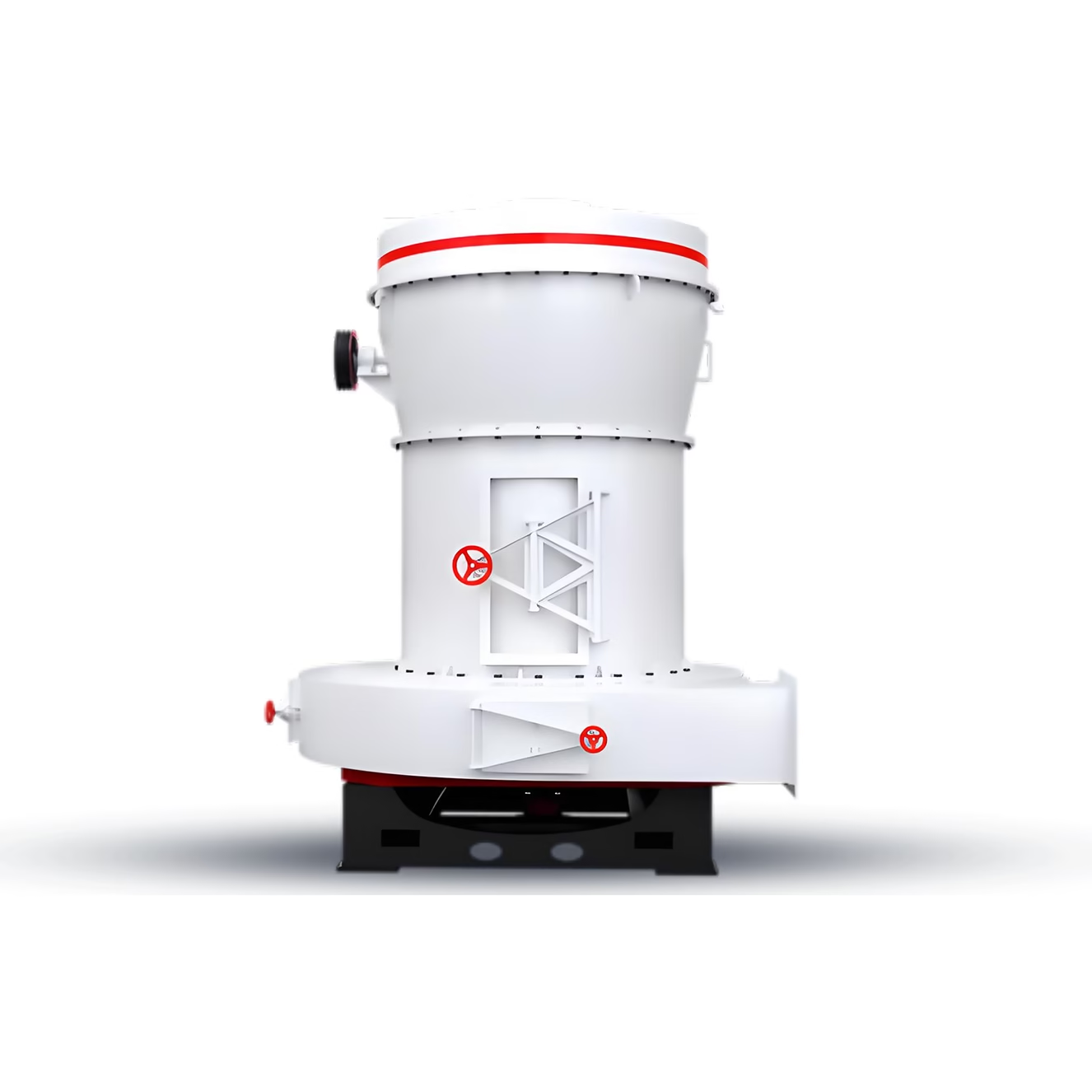
The Raymond Mill, or Pendulum Grinder, remains a highly relevant and profitable investment for a specific range of applications. Its value lies in its unbeatable combination of low initial cost, operational simplicity, and robustness, especially for producing powders in the 100-400 mesh range.
Many people see a Raymond Mill as a simple grinder. That is a critical misunderstanding. It is an air-swept classification system that uses a grinding zone to produce particles. Its genius is in its simplicity and the synergy of its components. The Raymond Mill’s working principle uses centrifugal force. As a central spider rotates, rollers swing outwards, pressing against a stationary grinding ring. Plows scoop material into the path of the rollers, and a constant airflow lifts the pulverized powder up to an internal classifier, which separates the fine product from the coarse rejects.
Its enduring popularity comes down to a few core truths:
Simplicity and Reliability: It has fewer complex parts than more modern mills. This translates to easier installation and maintenance and greater tolerance for tough operating conditions.
Low Capital Cost: The Raymond Mill price is significantly lower than that of a Vertical Roller Mill of similar capacity. For many projects, this makes it the most financially viable option.
Versatility: It effectively handles a wide range of non-metallic minerals with medium to low hardness.
Integrated Drying: The hot airflow required to lift the powder can also dry materials with moderate initial moisture (up to 6-8%), often eliminating the need for a separate dryer.
Why Do We Need a Raymond Mill?
Why choose a Raymond Mill over other grinding mills? The answer lies in its unique combination of efficiency and practical design features.
1. Small Footprint and System Integrity:
The vertical structure of the Raymond Roller Mill is a massive advantage. In many factories, space is very limited. This machine requires a relatively small area for installation compared to a ball mill system. But it is not just about size; it is about integrity. The Raymond Mill can complete a whole independent production system from the crushing of rough material to the clear packaging of the final powder, eliminating the need for complex extra systems.
2. High Screening Rate:
Product fineness is vital for customers. The screening rate of the Raymond Mill is very high, reaching up to 99%. This means that 99% of the powder produced will pass through the sieve of the required mesh size. This consistency is hard to achieve with other milling equipment. For producers of filler for paper or paint, this consistency ensures the product is top quality.
3. Durable Transmission System:
The transmission device of the main unit uses a sealed gearbox and pulley. This design ensures smooth operation and reliable functioning. ZONEDING uses high-quality gears that resist wear. This results in a machine that runs quietly, smoothly, and reduces maintenance headaches.
4. Long Service Life of Wear Parts:
The crucial components are made of high-quality steel. High manganese steel is used for the rollers and rings, making them incredibly tough. Because the wear parts last longer, less money is spent on replacements. The whole machine is durable and reliable. The Raymond Mill is built to handle the heavy workload of a busy mine or factory without frequent breakdowns.
What are Applications of Raymond Mill?
The applications of Raymond Mill are incredibly vast. Clients from many different industries rely on this technology, as it is not limited to just one sector.
Mining and Metallurgy:
This is the most common use. Mines use the mill to process ores before further refinement, helping prepare minerals for separation processes.
Chemical Industry:
Chemical plants use the powder grinding machine to grind raw materials into specific particle sizes needed for chemical reactions. Consistent powder size creates better chemical reactions.
Construction Materials:
In the construction industry, the mill processes gypsum for wallboard, limestone for cement, and marble for decorative fillers. The fine powder provides smooth finishes and strong structural integrity.
Power Plants:
A specific application is desulfurization. Power plants use the mill to grind limestone. This limestone grinding powder helps remove sulfur from exhaust gases, which is crucial for environmental protection.
Paint and Paper Making:
These industries require ultra-fine fillers. Talc, barite, and calcium carbonate processed by these mills are used as fillers to improve the texture and brightness of paper and paint. The precise control over 325 mesh powder makes the Raymond Mill perfect for these high-value products.
What is the Structure of Raymond Mill?
Understanding the structure in detail helps to maintain the machine better. The Raymond Mill is a complex assembly of several key components.
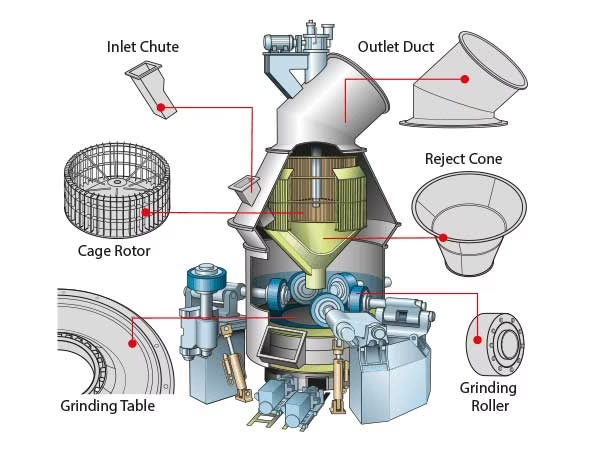
1. The Main Unit (Grinding Chamber):This is where the action happens. Inside the main frame, there is a central shaft. A mechanism called the “spider-arm” hangs from this shaft. The grinding rollers suspend from this arm.
2. The Analyzer (Classifier):This sits on top of the main unit and looks like a turbine. It spins to separate the fine powder from the coarse powder, determining the mesh size control. If the powder is fine enough, it passes through. If not, it falls back down.
3. The Blower:The blower provides the airflow. It blows air into the grinding chamber. This air carries the ground powder up to the analyzer.
4. The Cyclone Separator:This is the collection tank. The airflow carries the powder here. The cyclone shape forces the powder to drop to the bottom for collection, while the air returns to the blower.
5. Pipelines:Pipes connect all these parts. They create a closed loop for the air. This reduces dust in the factory.
ZONEDING ensures that the casting of the main unit uses high-strength steel to prevent vibration and noise. High-quality rubber seals are also used in the pipes to prevent air leaks.
What is the Working Principle of Raymond Mill?
The working principle relies on centrifugal force. It is a brilliant but simple physical concept.
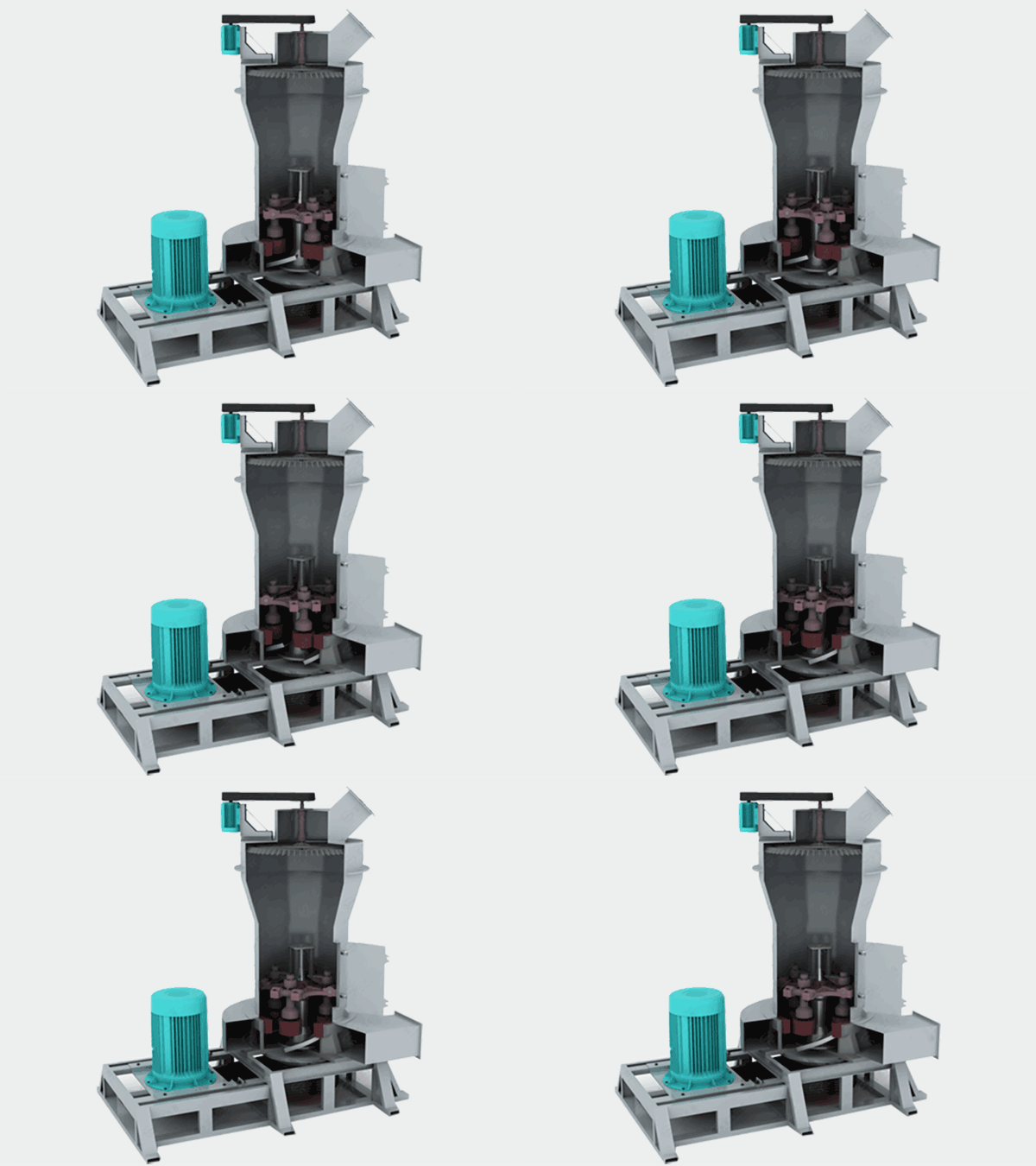
Inside the main unit, the central shaft rotates. The rollers hang from the spider-arm. As the shaft spins, centrifugal force pushes the rollers outward. They press hard against the stationary grinding ring. The pressure is immense.
There is also a tool called the “shovel blade.” This blade rotates with the rollers and sits below them. Its job is to scoop up the material from the bottom of the chamber and throw it into the space between the roller and the ring.
So, the grinding happens because the roller rolls over the material against the ring. It is like a rolling pin crushing a cookie, but with much more force and speed. The shovel ensures there is always material to crush. This continuous cycle involves scooping, pressing, and crushing. This is the core of the mineral pulverizer action.
How Does Raymond Mill Work? A Step-by-Step Process
Here is the entire journey of a stone turning into powder in a ZONEDING production line.
Step 1: Crushing:Big rocks from the mine are too large for the mill. They are first fed into a Jaw Crusher, which reduces the size to about 15mm-30mm.
Step 2: Elevating and Feeding:A bucket elevator lifts the crushed small stones into a storage hopper. From the hopper, an electromagnetic vibrating feeder feeds the material into the main unit of the Raymond Mill. The feeder ensures the rate is uniform to avoid choking the machine.
Step 3: Grinding:Inside the main unit, the shovel scoops up the material and feeds it between the rotating roller and the ring. The heavy roller grinds the material into powder.
Step 4: Classification:The blower blows air into the grinding chamber. The air lifts the powder up to the analyzer. The analyzer is a rotating wheel. Coarse particles are heavy; they cannot pass the analyzer and fall back down for re-grinding. Fine particles are light and pass through with the airflow.
Step 5: Collection:The airflow with the fine powder goes into the cyclone separator. Here, the powder separates from the air and falls out the discharge valve. This is the finished product.
Step 6: Air Recycling:The air returns to the blower through a return pipe. It recycles. This closed system keeps the workshop clean.
Raymond Mill vs. Vertical Mill: Which is the Right Investment?
This is the most common decision a modern investor faces. Both are excellent machines, but they are designed for different economic and operational priorities. Choosing the wrong one can permanently handicap your plant’s profitability.
A Raymond Mill is the ideal choice for projects with limited initial capital, producing powders up to 400 mesh. A Vertical Roller Mill is a better investment for large-scale operations requiring higher energy efficiency, a smaller footprint, and production of finer powders.
I have helped many clients make this choice. Here is the decision matrix I use:
Feature
Raymond Mill
Vertical Roller Mill (VRM)
Initial Investment
Lower. The primary advantage.
Higher. Can be 1.5x to 2.5x the cost.
Energy Efficiency
Good.
Excellent. Can save 20-30% in power consumption.
Fineness Range
Good (100 – 400 mesh).
Excellent. Can efficiently produce finer powders (up to 800+ mesh).
Footprint
Larger, horizontal layout.
Smaller, vertical design saves space.
Maintenance
Simpler. Easier to access and replace wear parts.
More complex, requires more specialized skills.
Single Unit Capacity
Moderate (up to ~50 tph).
Very High. Can exceed 100 tph in a single unit.
How do you select the right Raymond Mill model for your capacity and fineness needs?
Choosing the right size is critical. An undersized mill will never meet your production targets, while an oversized mill is a waste of capital and energy. The model numbers seem cryptic, but they are actually quite simple.
The Raymond Mill model (e.g., 3R, 4R, 5R) indicates the number of rollers. The full Raymond Mill specifications, like 5R 4119, further define the ring diameter. More rollers and a larger ring diameter directly translate to higher capacity.
Here is a general guide to help you match a model to your needs for a standard material like limestone, ground to 325 mesh:
Large-scale limestone grinding, power plant desulfurization.
What is the Price of A Raymond Mill?
A frequently asked question is, “What is the Raymond Mill price?” The truth is, the price varies. It depends on several factors. Here is what changes the cost.
1. Model and Capacity:Models are denoted by the number of rollers (e.g., 3R, 4R, 5R, 6R). “R” stands for Roller. A 3R mill is smaller and cheaper. A 5R or 6R mill is larger, has higher capacity, and costs more. A requirement of 1 ton per hour costs less than 20 tons per hour.
2. Fineness Requirement:If extreme fineness (like 400 mesh or more) is needed, a specialized analyzer or a different type of mill, like a High-Pressure Suspension Mill, might be required. This adds to the cost.
3. Auxiliaries:Does the project need just the main machine, or the full line including the jaw crusher, elevator, and control cabinet? A full turnkey solution costs more but saves integration headaches.
4. Manufacturer:As a factory direct supplier, ZONEDING offers a price advantage. Machines are manufactured in a 50,000-square-meter workshop and sold directly to the user. This removes the middleman’s markup.
To get an accurate price, contact ZONEDING with specific material and capacity needs for a quote.
Beyond the initial price, what are the real operating costs of a Raymond Mill?
A smart investor looks beyond the purchase price to the Total Cost of Ownership (TCO). For a Raymond Mill, this means understanding your spending on power and wear parts.
raymond mill structure
working princple of raymond mill
The two main operational costs for a Raymond Mill are electricity (power consumption** for the main motor and fan) and the regular replacement of wear parts, primarily the grinding roller and ring . The cost of these parts is directly related to the abrasiveness of the material you are grinding.
Let’s break it down:
Power Consumption: This is your largest ongoing cost. A complete system (mill, fan, classifier, crusher) for a 10 tph plant can have an installed power of 200-300 kW. The key to minimizing this is running the mill at a stable, optimal feed rate, not constantly starting and stopping.
Wear Parts (Consumables):
Roller & Ring: These are the primary wear components. For a soft material like limestone, they can last for over 2000 hours. For a more abrasive material like barite with high silica content, their life could be under 800 hours. You must budget for this.
Plows (Shovels): These are smaller, cheaper parts that scoop material in front of the rollers. Their condition is critical. Worn plows lead to poor grinding efficiency and can cause damaging metal-on-metal contact between the roller and ring. They are the cheapest insurance for your expensive parts.
What is the fineness limit of a Raymond Mill? Can I use it to produce ultrafine powder?
This is a common question driven by the demand for higher-value products. It is crucial to understand the mill’s technical limits to avoid disappointment.
The practical fineness limit for a standard Raymond Mill is around 400-500 mesh (about 25-30 microns). While it can produce small amounts of finer particles, it is not an efficient machine for producing true ultrafine powder (over 800 mesh). The limitation is in its air classification system.
The classifier (or separator) at the top of the mill spins to create a centrifugal field. Air flowing inwards carries the fine particles, while the centrifugal force throws coarser particles back into the grinding zone.
To get finer powder, you slow down the classifier. This reduces the centrifugal force, allowing the air to carry away finer particles.
The Limit: Below a certain speed, the classification becomes inefficient. You also have to drastically reduce the airflow and feed rate, causing the mill’s overall output to plummet. If your business plan relies on producing 1250 mesh powder, a Raymond Mill is the wrong tool for the job. You would need a ball mill with a high-performance classifier or a jet mill.
Why is my Raymond Mill output low or the powder uneven? (Common Problems & Solutions)
Many operators struggle with performance issues. In my experience, 90% of these problems are not due to the mill itself but to incorrect operation, especially a misunderstanding of the airflow.
The most common causes for low output or inconsistent fineness in a Raymond Mill are improper airflow settings, worn-out wear parts (especially plows), inconsistent feed size, or excessive moisture in the raw material.
Here are the solutions I provide most often:
Problem
Likely Cause
Solution
Low Production
Incorrect airflow (too low or too high); Worn plows.
Calibrate the main fan damper to achieve the correct air velocity. Check and replace worn plow tips.
Coarse/Uneven Powder
Classifier speed is too high; Worn classifier blades.
Reduce the classifier speed (requires a VFD for best control). Inspect blades for wear or blockages.
Ensure the feed is consistently below 25mm. Check wear parts for flat spots or chunking.
System Clogging
High moisture in feed condensing in the system.
Pre-heat the entire mill system with hot air before introducing feed. Ensure raw material is as dry as possible.
Which industries and materials are best suited for a Raymond Mill?
The Raymond Mill is not a universal solution, but for its target materials, it is often the most cost-effective one.
The Raymond Mill excels at grinding non-flammable, non-explosive, brittle materials with a Mohs hardness below 7. It is the dominant grinding equipment in industries producing powders for construction, chemicals, and fillers.
Main application materials:
Limestone and Calcite: For 325 mesh powder used in PVC, paint, paper, and animal feed.
Barite: Grinding for drilling mud applications (API grade).
Gypsum:Gypsum powder making for plaster and wallboard production.
Dolomite, Feldspar, Marble: For ceramics and glass industries.
Bentonite and Kaolin: For various filler and industrial applications.
Raymond Mill Price?
This is often the first question an investor asks. While the price varies by size and manufacturer, it is important to understand what is included.
The Raymond mill price for a complete system, including the main mill, motor, fan, cyclone, baghouse, and electrical controls, can range from $30,000 for a small 3R model to over $200,000 for a large 6R or 7R model. The final price depends on the model, configuration, and level of automation.
As a factory-direct manufacturer, we provide a complete, engineered solution.
What a ZONEDING Quotation Includes:
Main Mill Assembly: Includes rollers, ring, spider, and main frame.
Drive System: Main motor, gearbox, and couplings.
Classifier: Standard or optional high-efficiency turbo classifier.
Air System: Main fan, ductwork, and cyclone collector for primary product separation.
Dust Control: A pulse-jet baghouse for environmental compliance and capturing the finest product.
Control Panel: A central cabinet for starting motors and monitoring the system.
Technical Support: We provide foundation drawings, electrical diagrams, and installation guidance.
How to Choose the Right Raymond Mill?
Choosing the right grinding mill is critical for profit. Avoiding a machine that is too small or too big is essential.
Know Your Material: First, confirm the hardness. Is it soft like gypsum or hard like granite? Raymond mills are best for medium-hard minerals.
Define Output Size: What mesh size is needed? 100 mesh? 325 mesh? Make sure the chosen mill model can achieve this efficiently.
Determine Capacity: How many tons are needed per day? Be realistic. It is better to have slightly more capacity than needed. Buying a machine that is too small will bottleneck growth.
Check the Moisture: Ensure the material is dry enough (under 6%). If it is wet, a dryer will be needed first.
Verifying these details ensures the machine fits the job perfectly.
How to Maintain the Raymond Mill?
Maintenance is the secret to a long-lasting machine. Although ZONEDING builds tough equipment, it still needs care.
1. Lubrication:Add grease to the bearings regularly. The roller bearings work under high pressure and heat. It is suggested to check the oil levels every shift. Proper lubrication prevents seizing and overheating.
2. Check Wear Parts:Inspect the shovel blades, rollers, and grinding rings. These are Raymond mill spare parts that wear out. If the shovel is worn deeply, it won’t scoop material. This makes the machine run empty and wastes power. Replace them before they fail.
3. Tighten Bolts:Vibration is natural in grinding. It can loosen bolts over time. Check the anchor bolts and casing bolts weekly. A loose bolt can cause severe damage to the machine structure.
4. Monitor the Blower:Keep the airflow consistent. If the blower filter gets clogged with dust, efficiency drops. Clean the filters regularly.
Why Choose ZONEDING’s Raymond Mill?
ZONEDING offers the best value in the market for several reasons, combining a machine with 30 years of expertise.
Experience: Established in 1990, ZONEDING has seen every type of grinding problem and solved it, with 15 expert engineers constantly improving designs.
Factory Direct: Customers deal with the source. The 8000 square meter factory produces over 500 units a year. This scale allows for factory direct sales pricing.
Quality Components: No corners are cut. High manganese steel is used for wear parts. Trusted brands like Siemens and Omron are used for electrical controls, and Taiwan Kelly for hydraulics.
Global Reach: Equipment has been exported to over 120 countries. ZONEDING knows how to ship, install, and support machines internationally.
Full Service: One-stop solutions are provided. From the initial design of the plant to the installation and training of workers, support is continuous.
2025 Latest Raymond Mill Development and Trends
The technology of powder grinding is advancing. In 2025, distinct trends toward smarter and greener machines are visible.
Latest Developments At A Glance
Automation: New mills feature advanced PLC controls. Temperature, pressure, and output can be monitored from a central screen, reducing the need for manual labor.
Eco-Friendly Design: Dust control is a priority. Modern Raymond mills use pulse dust collectors. These capture 99.9% of the dust, keeping the air clean and meeting strict environmental laws.
Energy Efficiency: Improved motor designs and airflow dynamics mean newer mills use less electricity per ton of powder produced, lowering operating costs.
Market Insights
The demand for industrial minerals is growing. Construction and manufacturing need more limestone, barite, and calcite powder. The market is shifting towards finer powders and higher purity. Machines that can produce precise 325 mesh powder efficiently are in high demand. There is also a trend where customers prefer complete, mobile, or modular plants rather than buying individual machines.
Conclusion
The Raymond Mill is a fantastic investment when applied correctly. It offers a reliable, cost-effective solution for producing mineral powders in the most common fineness ranges. Understanding its capabilities, limitations, and operational nuances is the key to turning this classic machine into a modern, profitable production asset.
What is a Centrifugal Concentrator/Mining Centrifuge?
A Centrifugal Concentrator / Mining Centrifuge is a machine that uses centrifugal force to separate materials of different densities, commonly used in mineral processing.
What minerals can be processed with a Mining Centrifuge?
Mining Centrifuges effectively process gold, silver, platinum, tantalum, and other valuable heavy minerals from ore and tailings.
What are the benefits of using a Centrifugal Concentrator in mining?
Centrifugal Concentrators provide high recovery rates, low operating costs, and environmentally friendly mineral processing compared to traditional methods.
How does a Mining Centrifuge work?
A Mining Centrifuge uses a rotating bowl or cone to create centrifugal force, separating heavier minerals from lighter materials based on density.
What factors should I consider when choosing a Mining Centrifuge?
Consider feed rate, particle size, recovery rate, capacity, and maintenance requirements when selecting a Mining Centrifuge for your operation.
Contact us to review our catalog and get more information about our products.
 Zoneding Mining