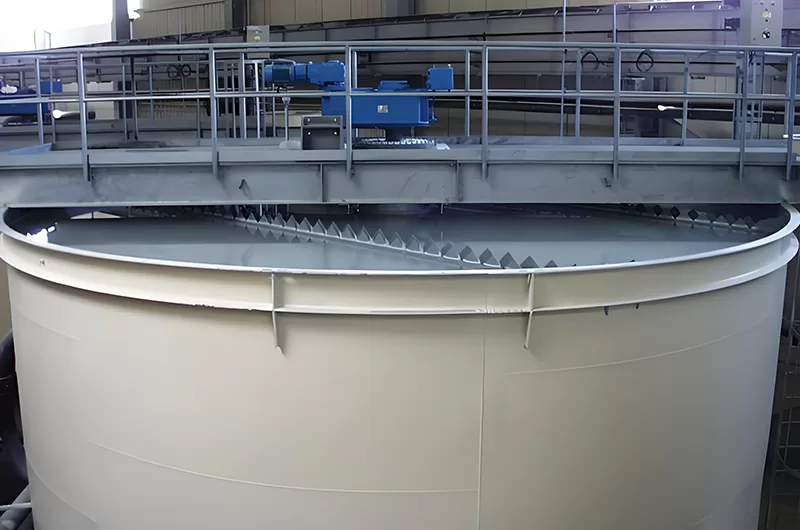
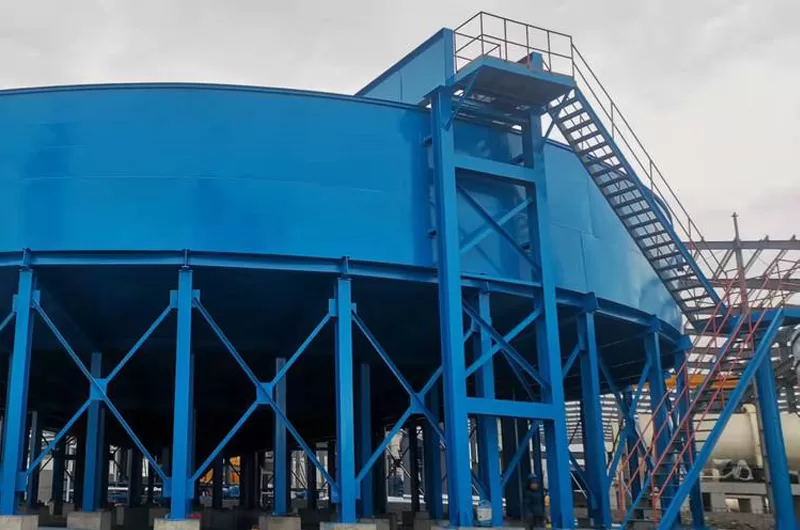
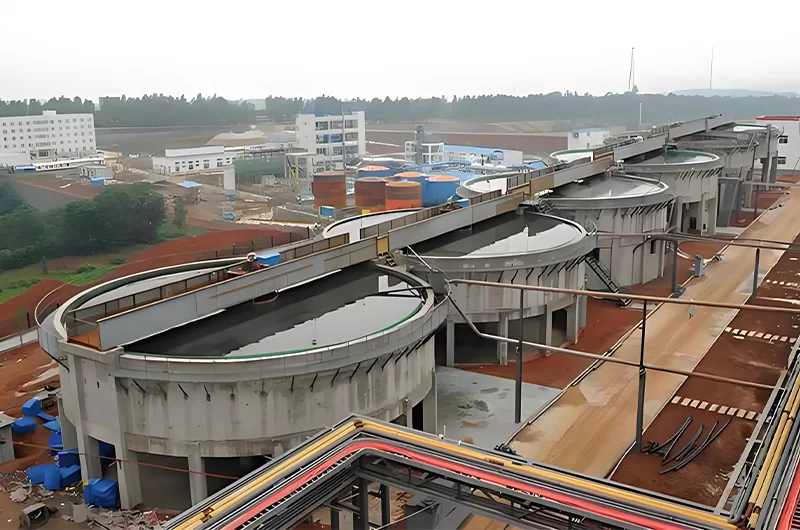
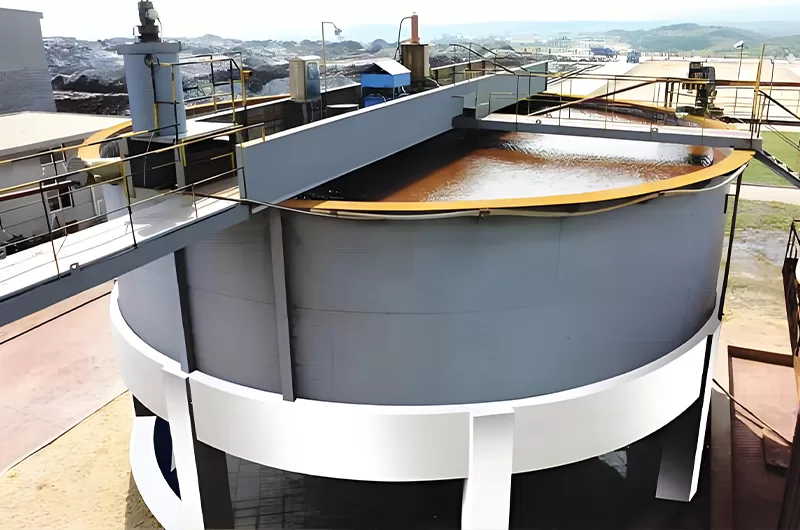
High efficiency concentrator is suitable to dewater concentrate and tailings in concentrator plant. The high efficiency concentrator produced by our company is a machine for removing the water in the ore concentrate and the tailings in the ore beneficiation plant.
Thickener (also known as thickener or agitator) is suitable for concentrate and tailings dehydration treatment during the beneficiation process to increase the slurry concentration from 20-30% to 40-70%. It is of great significance to improve the utilization rate of backwater, the concentration of bottom flow and protect the environment. In fact, the high efficiency concentrator is not a kind of simple sedimentation equipment, but a new type of dehydration equipment combined with the characteristics of mud layer filtration. It is divided into central transmission type, peripheral transmission type, sludge, intermittent type, vertical flow and continuous thickener.
What Defines a High Efficiency Concentrator?
A High Efficiency Concentrator is a solid-liquid separation device that uses flocculants and a specialized feed system to accelerate the settling of solids in a slurry.
It is often called a High Rate Thickener or an NZ series thickener. While it looks similar to a traditional thickener externally, the internal technology is vastly different. The defining feature is the integration of a deaeration tank and a flocculant mixing chamber. In standard gravity concentration, particles settle naturally, which takes a long time. In a High Efficiency Concentrator, chemicals bind fine particles into larger clusters called “flocs.”
These flocs are heavier and settle much faster than individual particles. This machine handles a significantly higher feeding capacity per square meter compared to conventional units. It serves as a critical bridge between the wet processing stage and final tailings disposal or filtration. For ZONEDING engineers, the definition centers on efficiency: doing more work in less space.
The Features of High Efficiency Concentrator
The flocculant is added to increase the particle size of settling solids, thus speeding up the settlement.
The inclined plate is installed to shorten the settlement distance of ore and increase the settlement area.
It can play a role in flocculating, filtering, compressing, and improve the treatment capacity of thick facies layer deposited by mud.
It is equipped with complete automatic control facilities.
What are the High Efficiency Concentrator Used For?
The High Efficiency Concentrator is versatile. It finds its place wherever water needs to be separated from solids.
Mineral Processing: In gold, copper, or iron ore plants, the concentrate needs dewatering before shipment. flotation concentrates are pumped here to remove excess water. This increases the density of the final product.
Tailings Management: This is the most common application. Tailings Thickening is essential for dry stack disposal or backfilling. The thickener recovers process water for reuse in the grinding circuit, while the thickened sludge is pumped to a tailings dam or filter press.
Coal Washing: Coal preparation plants produce large volumes of coal slime. This machine clarifies the slime water, recovering fine coal and clean water.
Sand Washing: Aggregate quarries generate muddy water. Sludge Dewatering Machines clarify this wash water, allowing quarries to recycle up to 80% of their water usage.
Chemical and Environmental Industry: Beyond mining, these units treat industrial wastewater, sewage sludge, and chemical byproducts, ensuring environmental compliance.
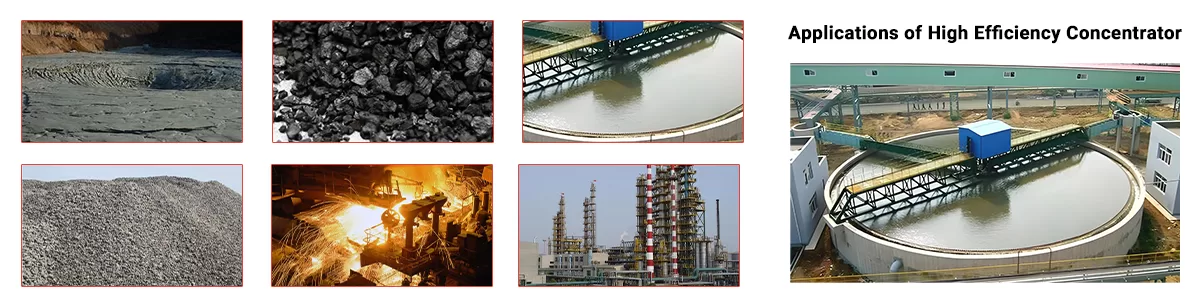
Applications of High Efficiency Concentrator
High efficiency concentrator is suitable for dehydration, concentration and treatment of tailings in concentrator factory, and widely used in metallurgy, chemical industry, coal, non-metallic mineral processing, environmental protection and other industries.
Why Is High Efficiency Thickening Crucial?
Thickening is not just about waste; it is about resource security.
Water Conservation:Fresh water is expensive and scarce. Industrial water recovery is a primary operational cost. A well-tuned thickener recycles vast amounts of process water instantly. This reduces the need to pump fresh water from rivers or aquifers.
Reduced Chemical Usage:By recovering process water, mines also recycle the reagents dissolved in that water. This lowers the cost of buying new chemicals for the flotation or leaching circuits.
Environmental Compliance:Governments enforce strict rules on tailings discharge. Discharging dilute, watery tailings creates massive, unstable dams. High-density thickening creates a stable, paste-like discharge. This reduces the risk of dam failure and groundwater contamination.
Downstream Efficiency:Equipment like filter presses or ceramic filters works better with high-density feed. The thickener prepares the sludge, ensuring subsequent dewatering equipment operates at peak performance.
The Structure Device of High Efficiency Concentrator
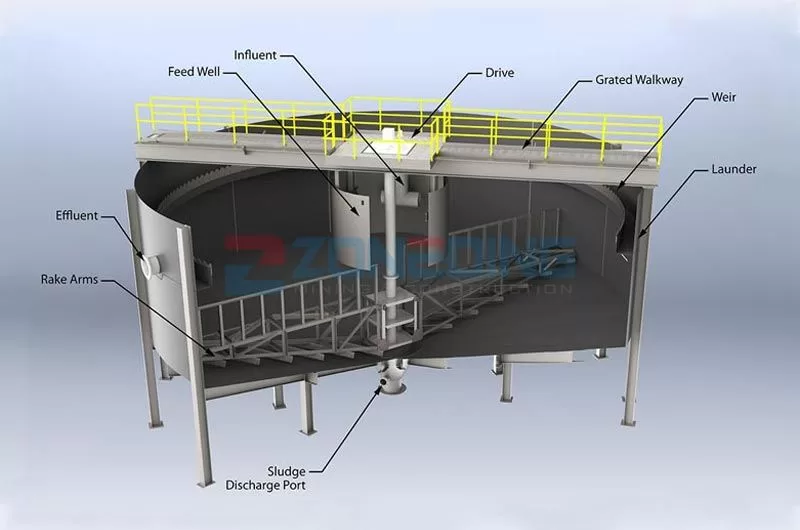
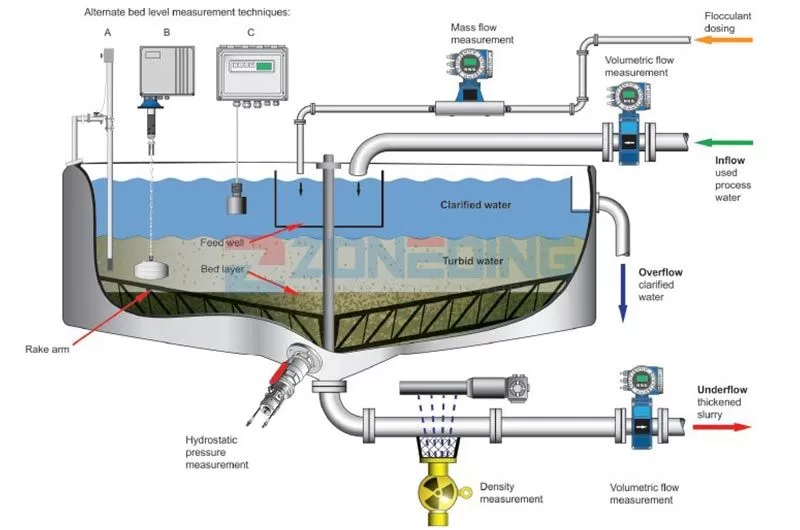
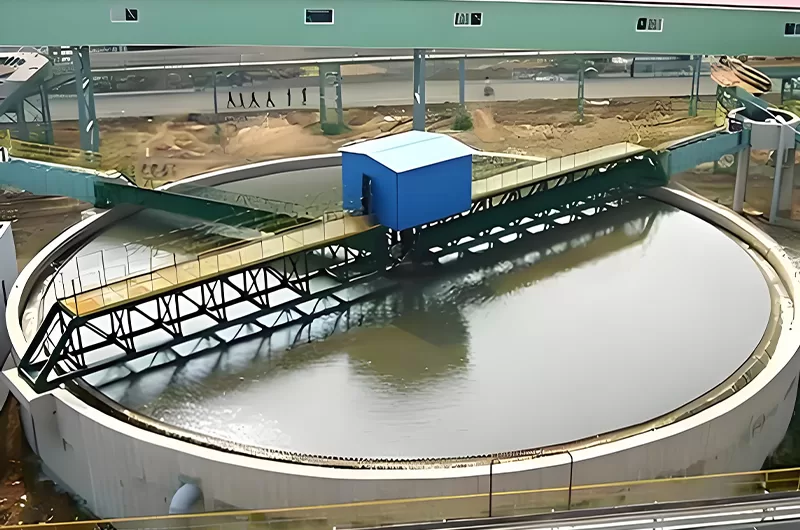
The high efficiency concentrator generally consists of the thickener pool, transmission device, lifting device, feeding device, unloading device and signal safety device. The main feature of this machine is to add a certain amount of flocculant to the pulp to be concentrated, so that the ore particles in the pulp will form flocculation groups and accelerate its settlement rate, so as to improve the concentration efficiency.
What are the Components of High Efficiency Concentrator?
A robust design ensures continuous operation. ZONEDING constructs these machines with heavy-duty components to withstand the torque of thick sludge.
1. The Tank:Usually made of welded steel plates or concrete (for very large diameters). It holds the slurry.
2. The Bridge:A steel structure spanning the tank. It supports the drive mechanism, feed pipes, and walkways for maintenance personnel.
3. Drive Unit:The heart of the machine. It powers the rotation of the rakes. Modern units use hydraulic or high-torque electrical drives with gear reducers.
4. Feed Well:Located in the center. It receives the slurry. This is where the magic happens. It contains mixing zones for flocculants and often a deaeration component to remove air bubbles that hinder settling.
5. Rake Scrapers:Long arms with angled blades at the bottom of the tank. They rotate slowly, scraping the settled sludge toward the central discharge outlet.
6. Overflow Weir:A channel around the top rim of the tank. The clear water rises and flows over this weir into a collection launder.
7. Deaeration Tank:A specialized chamber typically found upstream or at the feed inlet. It removes entrapped air from the slurry, preventing solid particles from floating.
How Does the High Efficiency Concentrator Work?
The Solid-Liquid Separation process in this machine is a choreographed sequence of chemical and physical actions.
Step 1: Deaeration:The slurry enters a deaeration tank first. Air bubbles are removed. If air remains attached to particles, they will float instead of sink.
Step 2: Flocculation:The slurry moves to the mixing chamber. Here, a specific dosage of flocculant (usually a polymer) is added. The mixture is agitated. The polymer chains attach to multiple fine particles, pulling them together into large, heavy “flocs.”
Step 3: Sedimentation:The flocculated slurry enters the tank through the feed well below the liquid surface. The heavy flocs settle rapidly to the bottom due to gravity.
Step 4: Clarification:As solids settle, clear water rises to the top. This clarified water flows over the perimeter weir and is recycled back to the plant.
Step 5: Compression and Discharge:The solids pile up at the bottom. The weight of the upper layers compresses the lower layers, squeezing out more water. The rotating rake mechanism scrapes this thick sludge toward the center cone. An underflow pump extracts the Underflow Density sludge for disposal.
The Working Principle of High Efficiency Concentrator
Increasing the size of solid particles in slurry and the settlement area of high-efficiency concentrator can improve the processing capacity of high-efficiency concentrator. The particle size of settling particles can be increased by adding flocculant to high-efficiency concentrator to make fine particles agglomerate.
The inclined plate in the high-efficiency concentrator can increase the settlement area, shorten the settlement distance of particles and improve the concentration efficiency. The test and industrial production shows that under the same processing capacity, the diameter of the high-efficiency thickener is only two-thirds to half of the diameter of the ordinary thickener, and the area is about one-ninth to one-fourth of the ordinary thickener, while the processing capacity per unit area can be increased several times to dozens of times.
What are Benefits of High Efficiency Concentrator Over Traditional Methods?
The industry has shifted away from simple gravity settling tanks. The High Efficiency Concentrator offers distinct advantages that impact the bottom line.
How Does High Efficiency Concentrator Outperform Traditional Tanks?
Speed:Traditional tanks rely on natural gravity. This is slow. High-efficiency units use chemical assistance to settle particles 10 to 20 times faster.
Automation:Old tanks often faced “raking torque” issues where the rake would get stuck in heavy mud. Modern units from ZONEDING feature automatic rake lifting thickener technology. Sensors detect torque overload and lift the rake automatically, preventing equipment damage and downtime.
Clarity:The overflow water from a high-efficiency unit is significantly clearer. The flocculants trap ultra-fine particles that would otherwise stay suspended in a traditional tank for days.
Traditional Thickener vs. High Efficiency Concentrator: Which Maximizes Land Use?
Footprint Efficiency:This is the most visible difference. To process 1000 tons of tailings per day, a traditional thickener might need a 50-meter diameter tank. A High Rate Thickener might achieve the same throughput with a 15 or 20-meter diameter tank.
Construction Costs:A smaller tank means less steel, less concrete foundation, and less piping. While the drive mechanism and control system of a high-efficiency unit cost more, the total civil engineering savings make it the more economical choice for maximizing land use and budget.
What Factors Influence the Price and Operating Cost of a High Efficiency Concentrator?
The High Efficiency Concentrator price is not fixed. It relies on custom specifications.
Tank Diameter:Size is the biggest cost driver. A larger diameter equals more steel and fabrication time.
Drive System:Hydraulic drives are more expensive than simple mechanical gearboxes but offer better control and specific torque monitoring. They are essential for heavy-duty applications.
Material of Construction:For corrosive environments (like gold leaching circuits or copper acid plants), the tank and rakes must be lined with rubber or made from stainless steel. This significantly increases the capital cost.
Automation Level:Adding PLC control panels, automatic flocculant dosing systems, and density meters adds to the initial price but lowers long-term operating costs by optimizing chemical use and reducing labor.
Peripheral Equipment:The cost also includes slurry pumps, water pumps, and Flocculant preparation stations. ZONEDING provides turnkey quotes that include these necessary auxiliaries.
How to Choose the Right Diameter and Tank Depth for Your Daily Capacity?
Selecting the dimensions is a scientific calculation, not a guess.
Settling Area Calculation:Engineers look at the “Settling Flux.” This is the mass of solids that can settle per square meter per hour. Laboratory tests on the specific ore determine this rate. If the ore settles slowly, a larger diameter is needed.
Retention Time:The tank must be deep enough to provide sufficient retention time. This allows the sludge to compress and reach the desired Underflow Density. Deeper tanks generally produce thicker underflow but are more expensive to build.
Capacity Factors:
Small Scale: For <100 tons per day, diameters of 3m to 9m are common.
Medium Scale: For 500-2000 tons per day, diameters usually range from 12m to 24m.
Large Scale: Major mines use thickeners exceeding 30m or 50m in diameter.
ZONEDING engineers perform sedimentation tests on client samples to recommend the precise diameter and depth, ensuring the layout is efficient.
How Does ZONEDING’s Hydraulic Drive System Prevent Rake Jamming?
One of the biggest fears in thickener operation is rake jamming. If the mud becomes too heavy, the rake can snap or the motor can burn out. ZONEDING addresses this with a smart hydraulic drive.
Torque Monitoring:The hydraulic system constantly monitors the pressure. Pressure correlates directly to torque.
Automatic Action:
Safety Level 1: If pressure rises above normal (indicating heavy load), the system sounds an alarm.
Safety Level 2: If pressure continues to rise, the hydraulic cylinders physically lift the rake arms up. This moves the blades out of the densest mud, reducing the load.
Restoration: As the rake rotates in the lighter upper mud, it gradually shaves down the sludge bed. The system slowly lowers the rake back to the bottom as the torque normalizes.
This automatic rake lifting feature ensures the machine can run 24/7 without catastrophic mechanical failure, even during power outages or process upsets.
What Are the Maintenance Requirements for High Efficiency Concentrator?
Keeping a Mineral Thickener running requires routine attention.
Daily Checks:Inspect the hydraulic power pack oil level and pressure. Check the flocculant dosing pump for blockages. Visually verify the clarity of the overflow water.
Weekly Tasks:Grease the central bearing and drive gears. Inspect the bridge structure for corrosion. Check the underflow pump seals.
Annual Maintenance:Drain the tank (if possible) to inspect the rake blades and rubber liners for wear. Replace worn scraper blades to ensure efficient mud movement. Calibrate the density meters and torque sensors.
Chemical Management:Regularly clean the flocculant mixing tank. Polymers can build up and act like glue, clogging pipes.
Technical Parameter of High Efficiency Concentrator
Model
GW-3
GW-5
GW-8
GW-10
GW-12
GW-20
GW-30
GW-40
GW-50
Filter area(m2)
3
5
8
10
12
20
30
40
–
Cylinder size(mm)
φ1068×1060
φ1600×1060
φ2000×1500
φ2000×1750
φ2000×2000
φ2500×2650
φ3350×3000
φ3350×4000
φ3350×5000
cylinder speed(r/min)
0.156-1.56
0.156-1.56
0.1-0.6
0.1-0.6
0.1-0.6
0.14-0.54
0.12-0.56
0.12-0.56
0.12-0.56
Vacuum pressure(KPa)
60-80
60-80
60-80
60-80
60-80
60-80
60-80
60-80
60-80
Swept volume(m3/min.m2)
0.5-2
0.5-2
0.5-2
0.5-2
0.5-2
0.5-2
0.5-2
0.5-2
0.5-2
Blast pressure(Kpa)
10-30
10-30
10-30
10-30
10-30
10-30
10-30
10-30
10-30
Blast volume(m3/min.m2)
0.2-0.4
0.2-0.4
0.2-0.4
0.2-0.4
0.2-0.4
0.2-0.4
0.2-0.4
0.2-0.4
0.2-0.4
Capacity(t/h)
0.8-1.5
1.6-2.4
2.8-3.6
3-4
3-5
3-8
4.5-12
6-16
7.5-20
Cylinder motor(kw)
1.5
1.5
2.2
2.2
2.2
3
4
4
5.5
Stirring motor(kw)
0.75
0.75
1.5
1.5
2.2
2.2
3
3
4
Weight(kg)
2635
2850
5455
6317
6365
10600
17200
19500
Customer Cases
What is a High Efficiency Concentrator / Mining Thickener?
A High Efficiency Concentrator / Mining Thickener is a sedimentation device used to separate solids from liquids, producing clarified water and concentrated slurry in mining.
What are the benefits of using a High Efficiency Thickener in mining?
High Efficiency Thickeners reduce water consumption, recover valuable minerals, minimize tailings volume, and improve overall mining process efficiency.
How does a Mining Thickener work?
A Mining Thickener uses gravity to settle solids in a large tank, with rakes assisting solids movement to the discharge point and clarified liquid overflowing at the top.
What are the key features of a High Efficiency Concentrator?
Key features of a High Efficiency Concentrator include a deep cone design, optimized feedwell, lamella plates (optional), and automated control systems for optimal performance.
What factors should I consider when choosing a Mining Thickener?
Consider feed solids concentration, particle size distribution, required underflow density, flow rate, and process chemistry when selecting a Mining Thickener.
Contact us to review our catalog and get more information about our products.
 Zoneding Mining