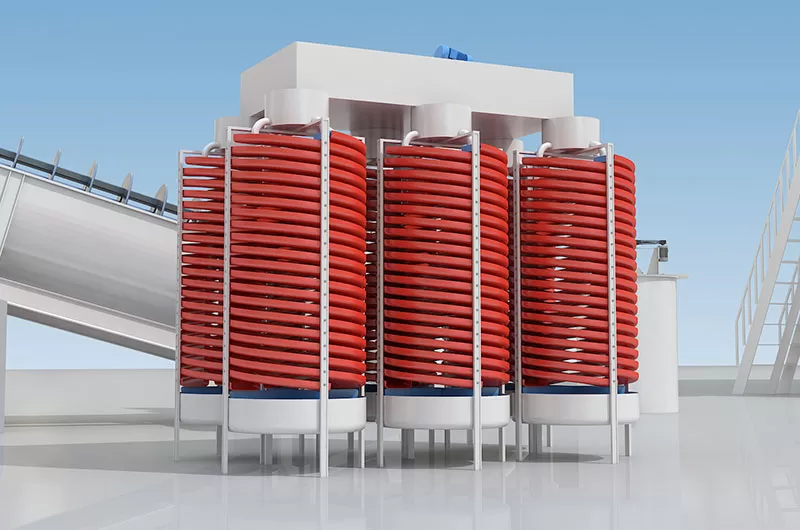
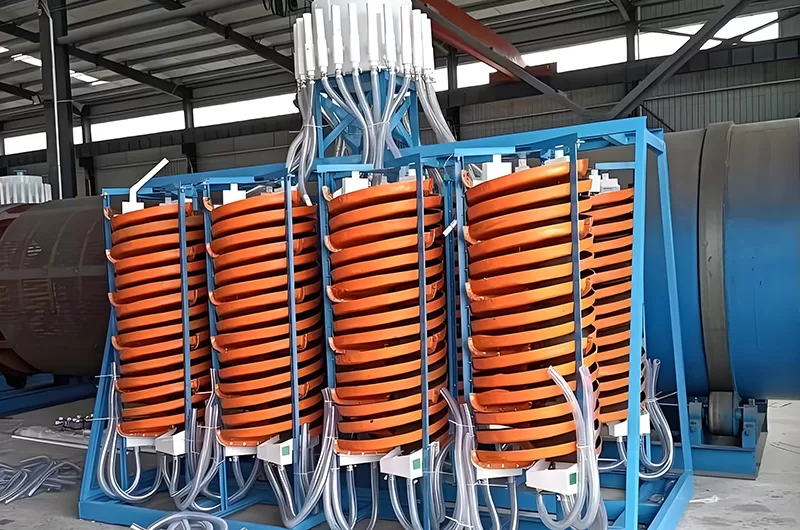
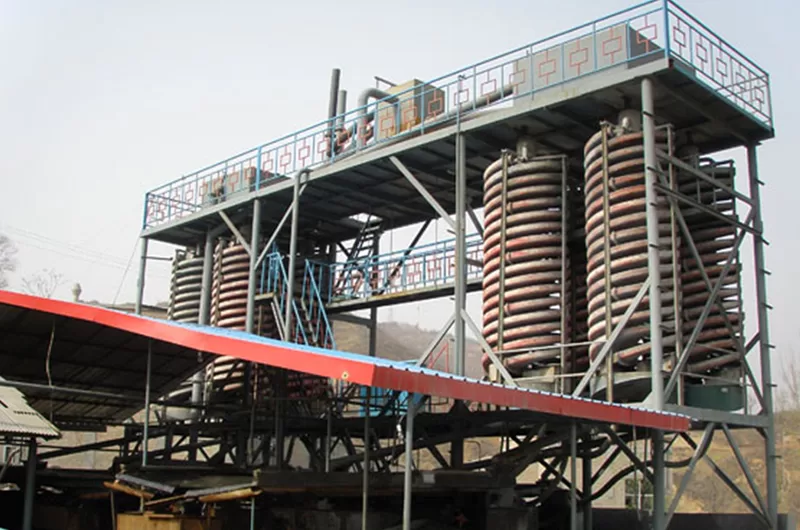
Spiral gravity separator spiral chute is also called spiral concentrator or gravity separator, it’s a kind of gravity concentrator which can separate mineral particles according to density, granularity and shape by the interaction of centrifugal force, friction force of chute surface, water flow pressure and gravity of minerals. Spirals are made of high-density fiberglass, high quality emery and unsaturated resin.
Spiral Chute Definition
A Spiral Chute is a gravity-based separation device used to separate minerals of different specific gravities using a flowing film of slurry in a helical trough.
Often called a Gravity Spiral Separator or simply a spiral, it combines the forces of gravity, centrifugation, and friction. It is physically a stationary trough that twists downward like a spiral staircase. It has no moving parts. This lack of moving components defines its identity in the mining industry. It is typically made of Fiberglass Reinforced Plastic (FRP), which makes it lightweight yet incredibly durable against corrosion and wear.
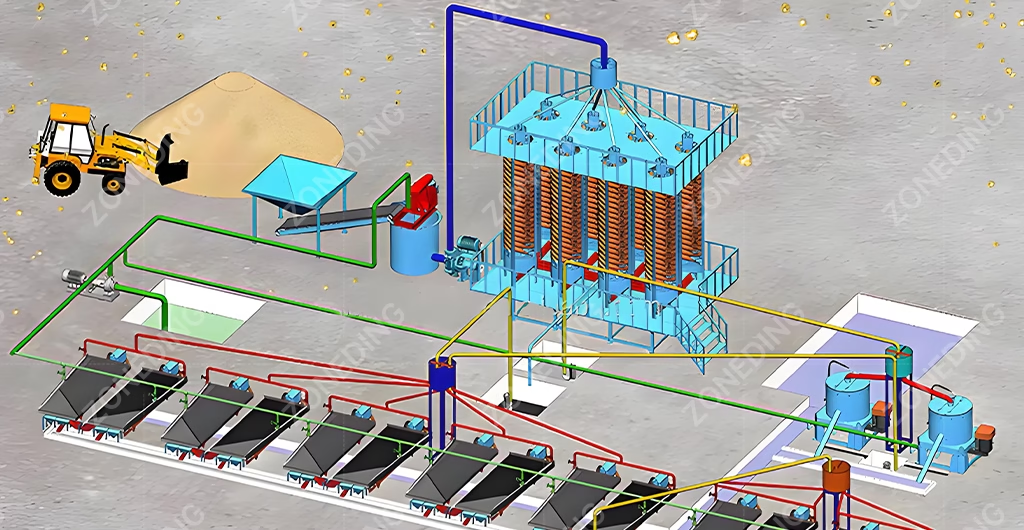
In a typical beneficiation flowsheet, the Mineral Spiral Separator sits between the initial grinding stage and the final cleaning stage. It is designed to process the “middle” fraction of particle sizes—usually between 0.3mm and 0.02mm.
Benefits and Advantages of Spiral Chute
Why do mines from South Africa to Australia rely on spiral chutes? The answer lies in the “Price-Performance Ratio.”
Zero Power Consumption:This is the biggest selling point. Once the slurry is pumped to the top of the spiral bank, gravity does 100% of the work. There are no motors, no belts, and no electricity required for the separation process itself. This drastically cuts operating costs (OPEX).
Minimal Maintenance:Because it has no moving parts, nothing breaks. There are no bearings to grease or gears to replace. The only maintenance required is occasional inspection of the surface lining.
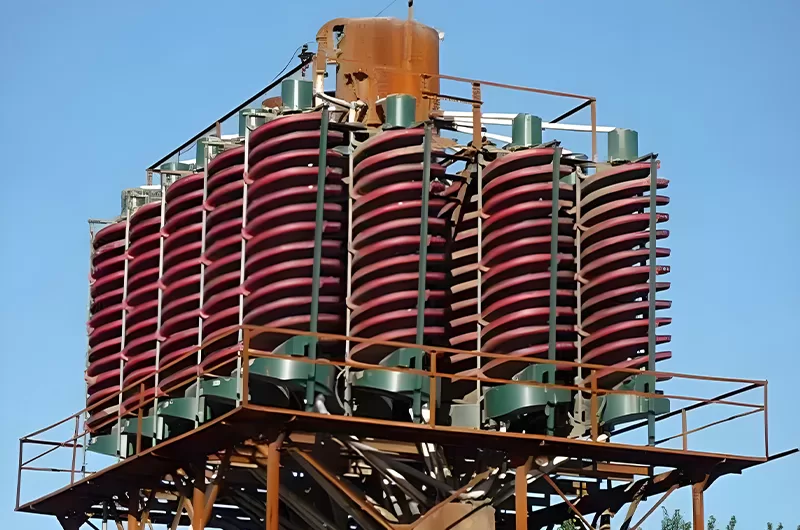
High Capacity:A single spiral column can process 2 to 6 tons of ore per hour. However, spirals are modular. You can install banks of 20, 50, or 100 spirals side-by-side to handle thousands of tons per day.
Water Efficiency:Compared to other gravity methods like jigs, the Spiral Chute generally consumes less water. It effectively utilizes the water present in the slurry feed.
Adaptability:It is insensitive to minor fluctuations in feeding volume and density. Even if your feed pump surges slightly, the spiral continues to separate effectively without needing constant adjustment.
What are Spiral Chute Used For?
The application range of the Spiral Concentrator is vast. It is used wherever there is a significant weight difference (Specific Gravity difference) between the valuable mineral and the waste rock.
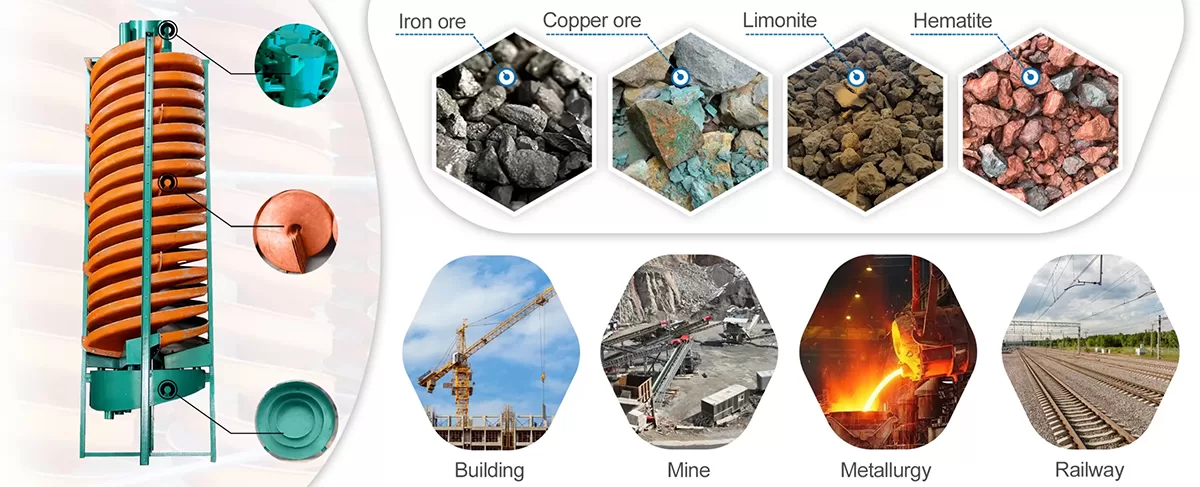
Metallic Minerals:It is the standard equipment for upgrading Iron ore (Hematite, Magnetite), Ilmenite, Chromite, Pyrite, Tungsten, and Tin. It removes the lightweight silica (sand) leaving the heavy metal concentrate.
Non-Metallic Minerals:In the silica sand industry, spirals are used in reverse. The goal is to remove heavy impurities (like iron or titanium) from the light silica sand to produce high-purity glass sand. It is also used for Zircon sand processing and Garnet recovery.
Coal Washing:Specialized larger spirals are capable of separating coal from shale. Coal is lighter and moves to the outside, while the heavy shale moves to the inside.
Application of Spiral chute
The spiral chute is suitable for separation of 0.3-0.02mm fine materials such as iron ore, ilmenite ore, chromite ore, pyrite ore, zircon ore, rutile ore, monazite ore, tungsten ore, tin ore, tantalum ore, niobium ore and other materials with enough specific gravity difference. It is the best roughing gravity equipment, which has been widely used in ferrous and nonferrous metal mines.
Placer Gold, Chrome, or Iron: What Ores Suit Spiral Chute Best?
While versatile, the Spiral Chute performs exceptionally well on specific ore types due to their density profiles.
Iron Ore Beneficiation:This is the largest global market for spirals. In processing Hematite or Magnetite, the rock is crushed and ground. The spiral separates the heavy iron needed for steel making from the light silica waste. ZONEDING spirals are specifically calibrated to handle the high density of iron ore slurries.
Chrome Ore Washing:Chromite is heavy. The gangue is light. Spirals are the primary method for roughing chrome ore. They quickly reject bulk waste, upgrading the content from 20% to roughly 35-40% before it is sent to shaking tables for final purification.
Placer Gold Mining:For alluvial gold, spirals act as excellent scavengers. While they might not catch the big nuggets (sluices do that), they are perfect for recovering fine gold from the sand tailings that sluice boxes might miss. They are also used to recover heavy black sands containing gold.
Spiral chute features
Reasonable structure and small area occupation, Non-required power
High recovery, high efficiency, and precise separation
Light in weight, anti corrosion, rust and wear resistant
Simple installation and Minimal maintenance requirements
Low operating cost and long working life
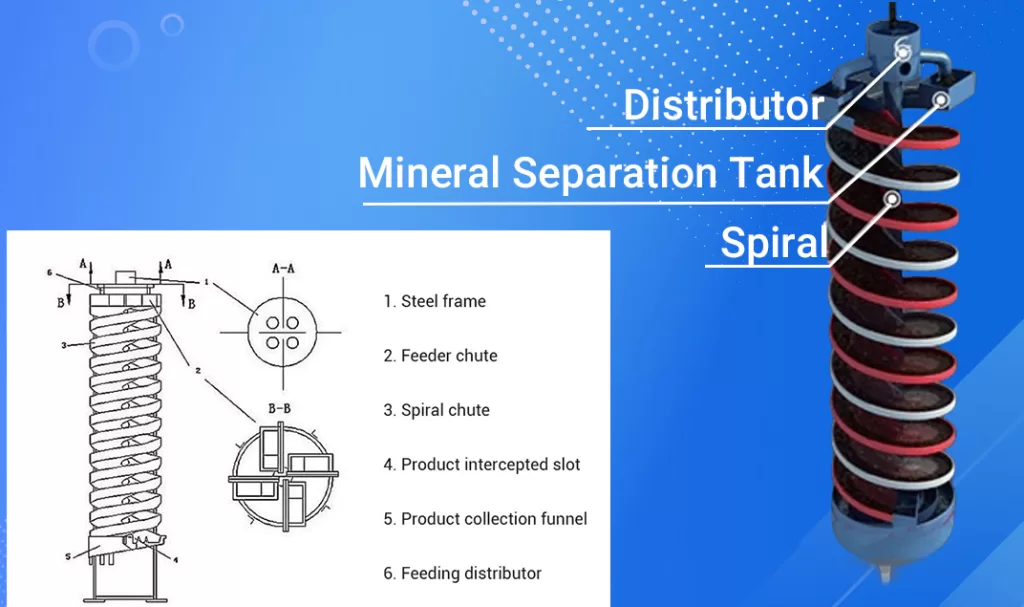
What Are Key Components of Spiral Chute?
Understanding the anatomy of the machine helps in installation and ordering spare parts.
1. Feeder (Feed Box):Located at the very top. It ensures the slurry is distributed evenly into each spiral start. A uniform feed is critical for a smooth flow.
2. Spiral Trough (Launder):The helical body made of fiberglass. The inner surface is the separation zone.
3. Product Splitters (Cutters):Located at the bottom discharge end. These are adjustable mechanically. You move them to physically slice the flow of material, directing concentrate to one pipe, middlings to another, and tailings to a third.
4. Support Stand:Usually made of channel steel (cross or triangular shape). It holds the spiral upright. ZONEDING pre-assembles these frames to ensure stability.
5. Discharge Hopper:catches the separated streams and directs them into the factory piping system.
Working principle of Spiral chute
The spiral chute parts have a distributor and feed chute in the upper part and a product interceptor and collection chute in the lower part. The entire equipment is framed vertically with steel frames.The spiral chute is similar to the thread shape. The movement of the materials inside can be divided into three stages: the material introduction stage, the material acceleration stage, and the material uniform velocity warehouse stage. The third stage lasts the longest and is the key to materials crushing.
How Can a Spiral Chute Work Without Electricity?
The magic of the Gravity Spiral Separator lies in physics, not electricity. It converts potential energy into kinetic energy.
The Three Forces:
Gravity: Pulls everything down.
Centrifugal Force: As the slurry flows around the curve, it wants to fly outward.
Friction: The surface of the chute provides resistance.
The Separation Process:When the slurry flows down, heavy particles (Iron, Gold) sink quickly to the bottom of the stream. They experience more friction against the chute surface, so they slow down. They gravitate toward the inner rim of the spiral.Light particles (Sand) stay on top of the water film. They experience less friction and move faster. The centrifugal force pushes these fast, light particles to the outer rim of the spiral.Essentially, the heavy stuff hugs the inside pole, and the light stuff washes to the outside wall.
How Much Does a Spiral Chute Cost?
The Spiral Chute is one of the most affordable pieces of mining equipment available.
Price Factors:
Diameter: A 1200mm diameter unit costs more than a 600mm laboratory unit.
Material: High-quality wear-resistant emery or Corundum lining costs slightly more but lasts years longer.
Quantity: Most mines buy spirals in “banks” of 4, 8, or 16. Buying in bulk significantly reduces the unit price.
Rough Estimates:
A single industrial-grade spiral chute (typically 5 turns) usually costs between $600 and $1,500 USD, depending on the specifications. However, since they are usually installed in groups, a bank of 4 might cost around $3,000 – $5,000. ZONEDING offers factory direct pricing, which eliminates the dealer markup.
How to Select the Suitable Gravity Separators for Your Project?
Choosing the right gravity mining equipment depends on particle size and volume.
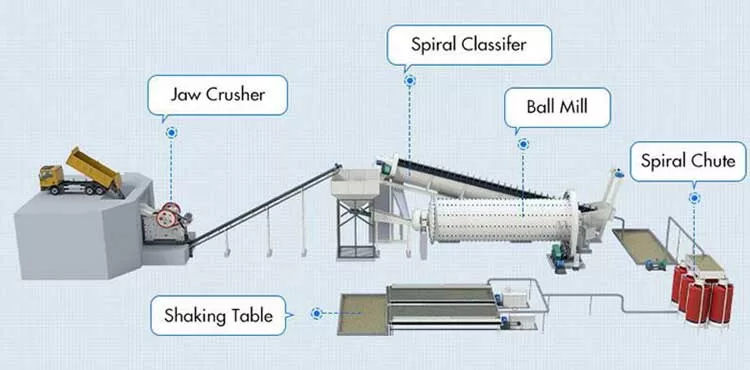
Spiral Chute vs. Shaking Table: Which One Fits Your Plant?
Spiral Chute: Best for “Roughing.” It handles huge volumes (4 tons/hour). It is good at throwing away a lot of waste quickly. But its enrichment ratio is lower. It gives you a “good” concentrate, but maybe not a “final” product.
Shaking Table: Best for “Cleaning.” It has a low capacity (0.5 – 1 ton/hour). But it is extremely precise. It gives you a very high-grade final product.
Why Is the Fiberglass and Emery for Spiral Chute Surface Critical?
The chute is made of Fiberglass Reinforced Plastic (FRP), but the surface is key. Inside the resin, ZONEDING embeds Emery (Corundum) or Silicone Carbide particles.
Wear Resistance: Slurry acts like sandpaper. Without this hard coating, the fiberglass would wear a hole in weeks. The emery layer makes it last for years.
Friction Coefficient: The rough emery surface grabs the heavy minerals, slowing them down so they move to the inner circle. If the surface is too smooth, the separation fails.
How Do Diameter and Pitch of Spiral Chute Affect the Separation Efficiency?
Diameter: The standard is 1200mm. Larger diameters (1500mm or 2000mm) handle more volume but are essentially for coal. Smaller diameters (600mm, 900mm) are for lower capacity or finer particles.
Pitch (Slope): This is the angle of the descent. A steady, predictable pitch ensures smooth flow. If the pitch is too steep, flow is too turbulent. If too flat, sand builds up and blocks the flow. ZONEDING engineers calculate the perfect pitch based on your ore’s density.
How to Configure a Multi-Stage Spiral Circuit (Roughing, Cleaning, Scavenging)?
To get maximum recovery, you rarely use just one pass. You create a circuit.
1. Roughing Stage:The raw ore enters the first bank of spirals.
Result: A rough concentrate (middlings) and a lot of waste (tailings). The waste is discarded immediately.
2. Cleaning Stage:The rough concentrate is pumped to a second bank of “Cleaner” spirals.
Result: This stage upgrades the material further. The concentrate here might be the final product or go to a shaking table.
3. Scavenging Stage:The middlings (the “maybe” material) from the rougher stage are sent to “Scavenger” spirals.
Result: This captures any good mineral that was accidentally missed in the first step. It sends the recovered material back to the start of the loop.
How Simple Is the Installation and Maintenance Process?
One of the best features of the Mineral Spiral Separator is its simplicity.
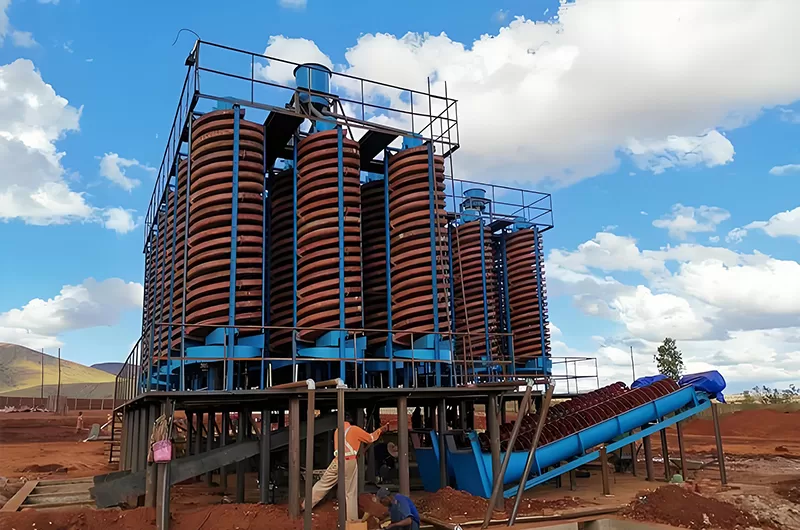
Installation:The units arrive in sections. You simply bolt the spiral blades onto the support column. The entire assembly is lightweight. A small team can assemble a localized bank of spirals in a day without heavy cranes. You just need to level the stand vertically—this is crucial. If it leans, the water flows to one side, ruining separation.
Maintenance:There is almost zero maintenance.
Check the lining: Every few months, check for wear spots.
Flush the pipes: Ensure the distribution pipes aren’t clogged with debris.
Wash down: Occasionally hose down the surface to preventing algae or scale buildup.
Why Choose ZONEDING’s Spiral Chute? What are their Strengths?
ZONEDING has been refining gravity separation technology since 1990.
Advanced Material: We use a high-grade imported resin and wear-resistant corundum liner. Our spirals resist deformation and maintain their precise shape even in hot outdoor environments.
Customization: We don’t just sell “off the shelf.” We can adjust the pitch and the number of turns (3, 4, or 5 turns) based on your specific mineral density.
Integrated Solutions: We provide the matching slurry distributors and piping systems to ensure your spiral bank works as a unified system.
Global Track Record: Our machines are currently separating chrome in South Africa, gold in Sudan, and iron in Australia. We know what works in the field.
Technical Parameter of Spiral chute
Model
Processing capacity(t/h)
DL2000
15-40
DL1500
8-16
LL1200
4-6
LL900
2-3
Customer Cases
What is a Spiral Chute?
A Spiral Chute is a gravity-fed separator that uses a helical pathway to separate minerals based on density and particle size.
How does a Spiral Chute work?
A Spiral Chute uses a combination of gravity, centrifugal force, and frictional drag to stratify and separate valuable heavy minerals from lighter waste materials.
What materials can be processed using a Spiral Chute?
Spiral Chutes are commonly used for separating coal, iron ore, rutile, zircon, ilmenite, and other heavy minerals from sand and gravel.
What are the advantages of using a Spiral Chute?
Spiral Chutes offer low operating costs, high capacity, simple operation, and no moving parts, making them a cost-effective separation solution.
What factors should I consider when selecting a Spiral Chute?
Consider feed rate, particle size distribution, mineral density, chute material, and number of turns when choosing a Spiral Chute.
Contact us to review our catalog and get more information about our products.
 Zoneding Mining