 Zoneding Mining

Site Search
Search products, equipment and solution articles
整站搜索产品中心新闻中心
点击开始搜索
热门搜索
UltraForm-MXFlexiPoly-RNanoForm Z300EcoFab P200
Search products, equipment and solution articles
If you’ve ever managed a construction project or ordered bulk materials, you have probably encountered the confusing world of crushed stone numbers. Terms like #57 stone, #8 gravel, or #10 screenings can seem like an arbitrary code. But choosing the right size is one of the most critical decisions for the success of your project. Using the wrong grade can lead to poor drainage, a weak concrete mix, or an unstable driveway that requires constant repair.
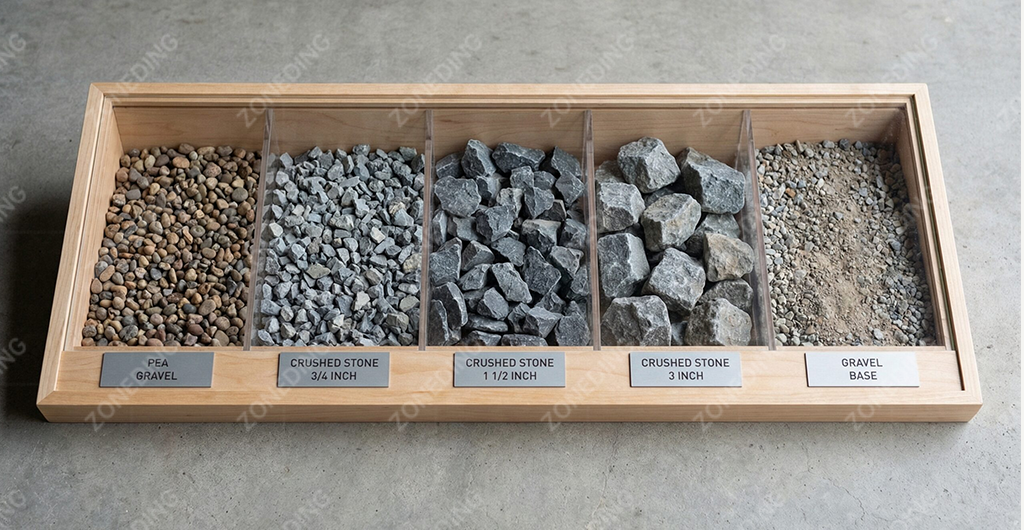
So, what do these numbers actually mean? And how are these perfectly uniform crushed stone sizes produced from massive, irregular boulders?
This guide is here to demystify the entire process. We will break down the crushed stone grading system in simple terms, show you a clear chart of the most common sizes and their uses, and then walk you through the complete aggregate production line that makes it all possible. By the end, you’ll be able to select the perfect aggregate size with confidence.
Last Updated: February 2026 | Estimated Reading Time: 18 Minutes
Before we get to the numbers, it’s essential to understand why size matters. The performance of crushed stone is determined by two main factors:
Choosing the right size is a trade-off between drainage and compaction. Get it wrong, and you could end up with a waterlogged foundation or a lumpy, shifting driveway.
The numbers used to classify crushed stone sizes are part of a grading system developed by standards organizations like AASHTO (American Association of State Highway and Transportation Officials). In simple terms, each number represents a specific range of stone sizes, determined by which screens the stone can pass through.
For example, #57 stone means that the majority of the stone passes through a 1.5-inch screen but is retained on a No. 4 sieve (about 3/16 inch). It’s a “clean” or “open-graded” stone, meaning it has very few fine particles (dust or sand), which makes it excellent for drainage.
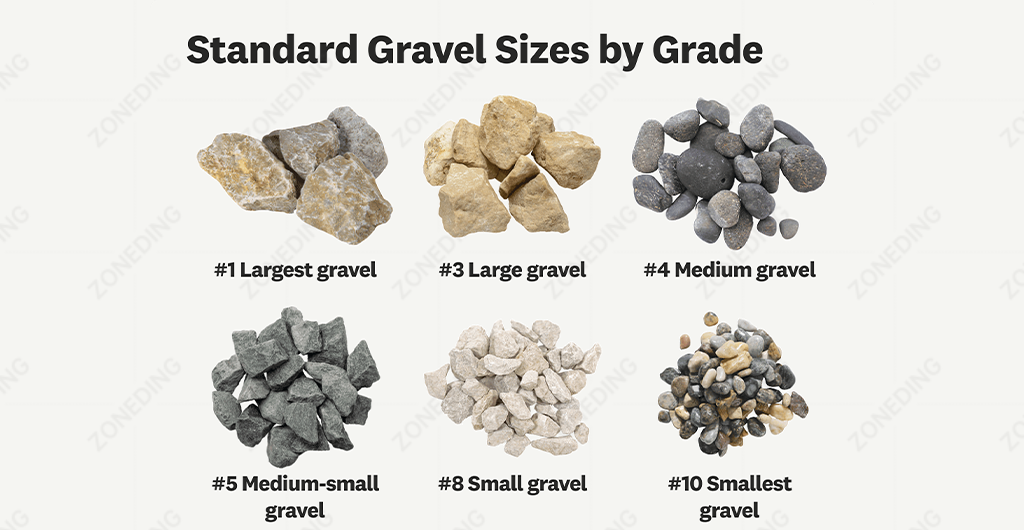
This chart covers some of the most widely used aggregate sizes.
| Common Size Number | Nominal Size Range | Common Uses & Key Characteristics |
|---|---|---|
| #1 Stone | 2″ to 4″ | Uses: Large-scale projects, erosion control (riprap), stabilizing very soft ground. Characteristics: Very large voids, excellent drainage, not for driving surfaces. |
| #3 Stone | 1″ to 2″ | Uses: Railroad ballast, drainage systems, septic fields, base for driveways in very wet areas. Characteristics: Good drainage, provides a sturdy base. |
| #8 Stone | 3/8″ to 1/2″ | Uses: Mixing in concrete and asphalt, landscaping, pathways. Characteristics: Small, uniform stone, also known as “pea gravel.” Good for decorative purposes. |
| #10 Stone / Screenings | < 3/8″ (Sand-like) | Uses: Paver base, making concrete blocks, filling gaps, traction on icy surfaces. Characteristics: Very fine particles, excellent for compaction. |
| #57 Stone | 3/4″ to 1″ | Uses: The most common construction gravel. Concrete mix, driveways, drainage (French drains), retaining wall backfill. Characteristics: Excellent balance of drainage and compaction. |
| #67 Stone | 3/4″ to fine | Uses: Road base, fill material, slab base. Characteristics: Similar to #57 but with more fine particles for better compaction. |
| Crusher Run | 3/4″ to dust | Uses: Driveway base, road base, sub-base material. Characteristics: A mix of all sizes from 3/4″ down to fine dust. Compacts very tightly to form a solid, stable surface. |
The uniform, numbered sizes you buy don’t come out of the quarry that way. They are the result of a carefully designed aggregate production line, a process where ZONEDING’s equipment plays the central role. The entire operation can be broken down into four main stages.
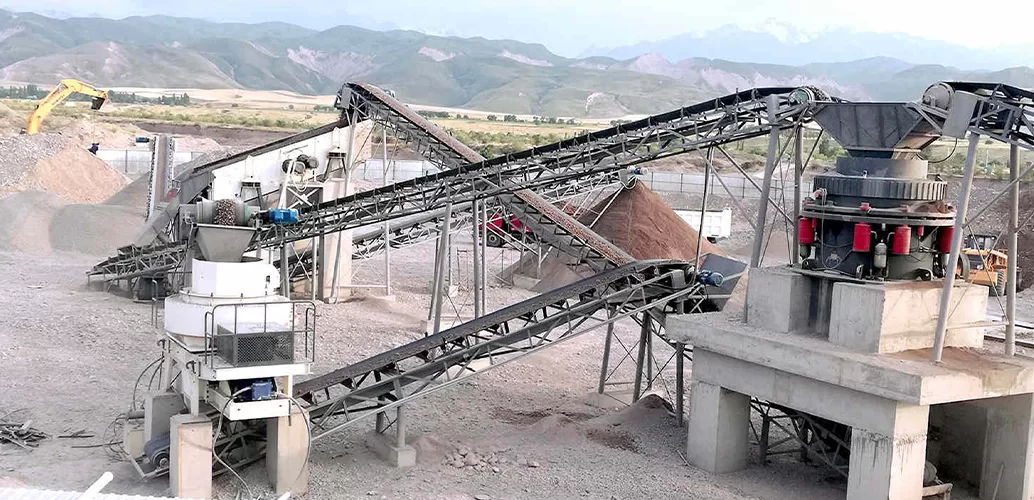
It all starts with massive boulders extracted from a quarry. These run-of-mine rocks are too large for any secondary machine, so they are first fed into a Jaw Crusher. A jaw crusher acts like a giant mechanical mouth, using immense compressive force to break boulders down into a more manageable size, typically around 6 inches (150mm). ZONEDING’s PE series jaw crushers are the workhorses of this stage, known for their reliability and high throughput.
The output from the jaw crusher is then transported by conveyor to secondary and tertiary crushers.
This multi-stage process is crucial for efficiently reducing the rock to the target size range.
This is the most critical stage for creating specific crushed stone sizes. After being crushed, the mixed aggregate is fed onto a large, multi-deck Vibrating Screen.
Think of it as a massive, industrial-sized sieve with multiple layers.
By configuring the screen sizes on each deck, a producer can create any standard aggregate size with high precision. ZONEDING vibrating screens are designed for high efficiency and accurate separation, ensuring a consistent final product.
For some applications, like concrete aggregate, the stone needs to be washed to remove dust and clay. A sand washing machine or log washer can be used for this. Finally, separate conveyors transport the finished, graded materials like #57, #8, and #10 stone into distinct piles, ready for sale.
| Project Type | Recommended Stone Size(s) | Why It Works |
|---|---|---|
| Gravel Driveway | Base Layer: Crusher Run or #3 Stone. Top Layer: #57 Stone. | Crusher Run compacts into a nearly solid base, preventing potholes. The #57 stone on top provides a clean driving surface with good traction and drainage. |
| Concrete Mix | #57 Stone and #8 Stone. | The #57 stone provides the primary structural aggregate, while the smaller #8 stone helps fill the voids, creating a stronger, denser, and more workable concrete mix. |
| French Drains / Drainage | #3 Stone or #57 Stone. | These are “clean” stones with large voids. They allow water to flow through easily without clogging, which is the primary function of a French drain or drainage field. |
| Paver Patio Base | Base Layer: Crusher Run. Bedding Layer: #10 Screenings. | The Crusher Run provides a solid, compacted foundation that won’t shift. The fine #10 screenings create a smooth, easily leveled bed for the pavers to sit in. |
Challenge: A construction materials supplier in the Philippines wanted to start producing the most in-demand crushed stone sizes for the local market: #57, #8, and G1 (a local equivalent of crusher run). They were processing hard river stone and needed a durable and efficient 100 TPH production line.
Solution: ZONEDING designed a complete aggregate production line.
Result: The client was able to produce high-quality, accurately graded aggregates that met all local construction standards. The efficient and reliable performance of the ZONEDING equipment allowed them to become a key supplier in their region, delivering a strong return on their investment.
The seemingly complex world of crushed stone sizes is actually a logical system designed to ensure the right material is used for the right job. From the massive voids of #1 stone for erosion control to the fine, compactable #10 screenings for paver bases, each grade has a specific purpose rooted in basic engineering principles.
Understanding this system, and the aggregate production line that creates these products, empowers you to make smarter material choices, leading to better, longer-lasting projects. The entire process, from a raw boulder to a perfectly graded #57 stone, is made possible by robust and precise crushing and screening equipment.
Need to produce your own high-quality aggregates?
Contact the experts at ZONEDING today. We provide factory-direct, one-stop solutions for aggregate production lines of any scale.
Last Updated: January 2025
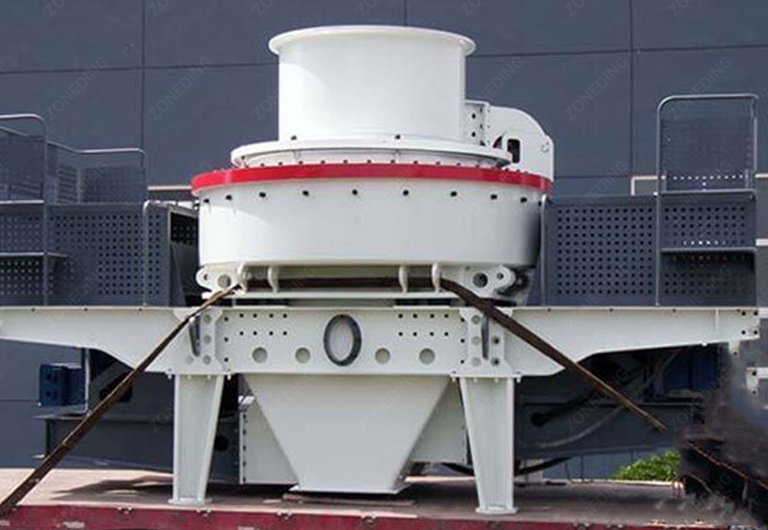
Learn what a sand making machine is, how it works, and its vital role in producing high-quality manufactured sand (M-sand) for modern construction projects.
View details
Looking for silver recovery solutions? We detail the 3 most common silver extraction process methods: Gravity Separation,Flotation, and Cyanidation Leaching.
View details
Get the ultimate guide to crushers vs. breakers. Understand differences, applications, and key selection criteria. Make informed decisions with confidence.
View details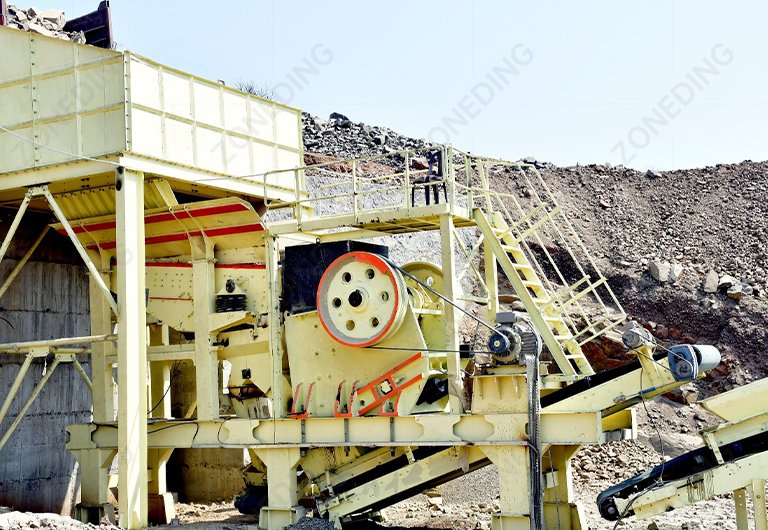
Looking for the best rock crusher for gold? Our guide compares Jaw, Cone, and Hammer Mill crushers to maximize your gold recovery from hard rock.
View details