 Zoneding Mining

Site Search
Search products, equipment and solution articles
整站搜索产品中心新闻中心
点击开始搜索
热门搜索
UltraForm-MXFlexiPoly-RNanoForm Z300EcoFab P200
Search products, equipment and solution articles
Tailings are often seen as waste, but in the modern mining world, they are actually “forgotten reserves.” Pegmatite tailings—the leftover sand and slurry from old mining operations—often contain significant amounts of lithium, tantalum, niobium, and caesium. These minerals were often missed by older, less efficient technology. Today, with the surge in demand for electric vehicle batteries and high-tech electronics, reprocessing these tailings is one of the most profitable moves a mining company can make. At ZONEDING, we help miners turn their waste ponds into profit centers by applying the latest mineral processing technology. We design systems that capture the fine particles that previous generations of equipment simply threw away.
Last Updated: April 2026 | Estimated Reading Time: 25 Minutes
Pegmatite tailings reprocessing is the act of collecting old mining waste and running it through a modern processing circuit to extract remaining valuable minerals. Pegmatite is a coarse-grained igneous rock. It is the primary source of lithium (spodumene) and tantalum (coltan). In the past, many mines used simple gravity methods. These methods worked for large crystals but missed the fine-grained minerals. This resulted in “rich waste” sitting in tailings dams for decades.
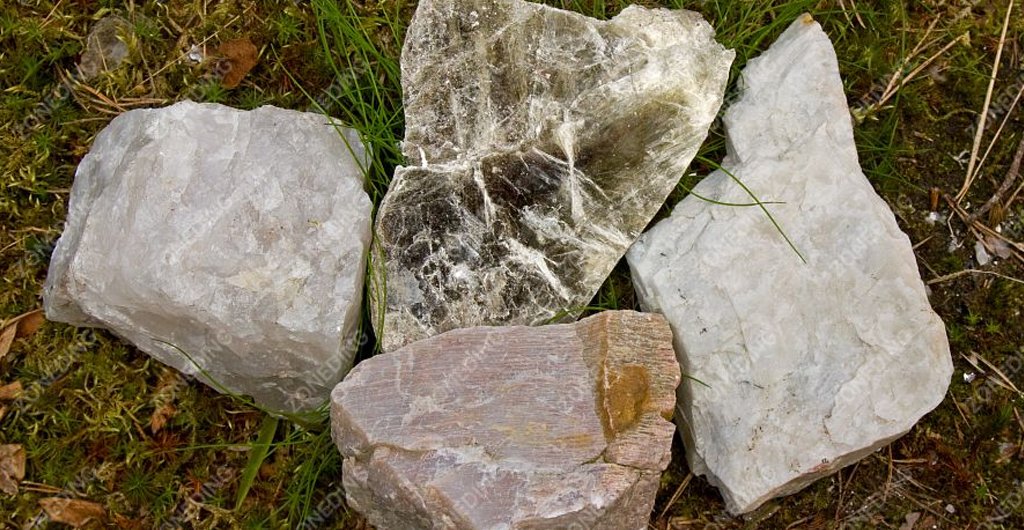
We approach reprocessing as a precision exercise. Unlike raw ore, tailings are already crushed and partially ground. This means you can skip the primary crushing stage, which saves a massive amount of energy and CAPEX. However, tailings are often saturated with water and contaminated with clay. We design specialized feeding and scrubbing systems to handle this material. ZONEDING focuses on “fine mineral recovery.” We use a combination of advanced magnetic separation and flotation to ensure that even the microscopic particles of lithium and tantalum are captured. This process not only generates revenue but also cleans up the environment by removing hazardous waste from old dams.
The economics of reprocessing have changed because of three main factors:
| Driver | Past Situation | 2025 Situation | Your Practical Gain |
|---|---|---|---|
| Market Price | Low demand for Lithium | Massive EV battery demand | Higher ROI per ton of waste |
| Technology | Simple Shaking Tables | High-G Centrifuges/AI Sorting | Higher recovery percentages |
| Environment | Waste ponds ignored | Strict “Green Mining” laws | Reduced liability and fines |
The goal of reprocessing is to liberate the valuable mineral from the waste rock and concentrate it into a sellable product. Since the material is already fragmented, the flow is shorter than a traditional mine. We focus on cleaning the material and using highly selective separation methods. We ensure that each stage of the plant is balanced to avoid bottlenecks, as tailings can fluctuate in density and moisture.
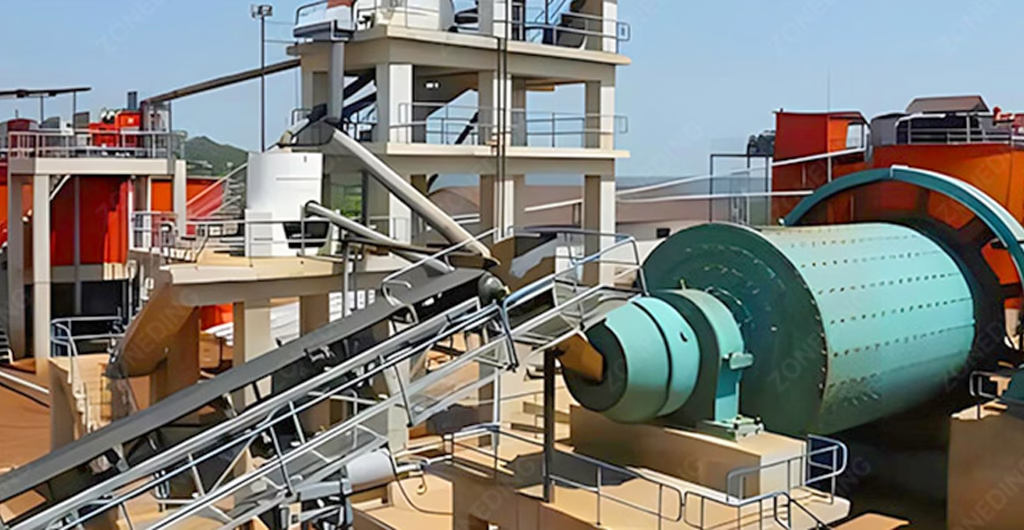
The typical ZONEDING flow for pegmatite tailings is as follows:
| Stage | Primary Equipment | Main Goal | Why it Matters |
|---|---|---|---|
| Preparation | Hydrocyclone / Scrubbers | Remove Clay | Prevents “blinding” of separators |
| Grinding | Ball Mill / Rod Mill | Liberation | Frees the mineral from the quartz |
| Roughing | Shaking Table / Spirals | Bulk Separation | Reduces volume for final stage |
| Cleaning | Magnetic Separator | Purification | Increases the final market price |
| Finishing | Centrifuge / Filter Press | Dewatering | Creates a dry, shippable product |
Selecting the right separation technology depends entirely on the magnetic and physical properties of the target mineral. Pegmatite is complex because it often contains several different minerals at once. For example, spodumene (lithium) has different properties than columbite-tantalite. We do not believe in a “one size fits all” approach. We customize the equipment based on the specific mineral you want to recover.
| Target Mineral | Primary Property | Best Technology | ZONEDING Equipment |
|---|---|---|---|
| Tantalum / Niobium | High Density / Magnetic | Gravity → Magnetic | Centrifuge → Magnetic Separator |
| Lithium (Spodumene) | Low Density / Weak Magnetic | Magnetic → Flotation | High-Intensity Magnetic Separator |
| Caesium / Beryllium | Chemical Specific | Flotation | Specialized Flotation Cells |
| Heavy Minerals | High Density | Gravity | Shaking Table / Spiral |
Processing waste is often harder than processing fresh ore because the material is degraded and inconsistent. We have seen many projects fail because the owner used a “fresh ore” mindset for “waste material.” Tailings are not uniform. The mineral grade changes every few meters as you dig into the pond.
Designing a tailings plant requires a shift in thinking. You are not just buying machines; you are designing a recovery chemistry. You must not simply buy the largest machine you can find. Instead, you must match the equipment to the “liberation size” of your minerals.
When selecting your equipment, consider these factors:
The industry is moving toward “Zero Waste” mining. In 2026, the goal is to leave the tailings pond completely empty of any value.
ZONEDING is currently developing “Hybrid Circuits.” These combine the speed of gravity separation with the precision of AI sorting. This allows miners to process more tons per hour while actually increasing the purity of the final concentrate.
Pegmatite tailings are a goldmine—literally. By recovering lithium and tantalum from old waste, you increase your ROI and improve your environmental standing. The key to success is a three-step approach: first, perform a deep-core audit of the tailings; second, use a scrubbing system to remove clays; and third, use a “split-stream” circuit of magnetic and gravity separation.
Your next step should be a material analysis. Collect samples from the top, middle, and bottom of your tailings dam. Send these to ZONEDING. We will run a liberation test to find the exact particle size of your minerals and provide a custom plant layout designed to maximize your recovery rate.
Last Updated: April 2026
Dive into technologies behind potash production. This Blog tells solution mining, flotation, crystallization, and techniques used to create potassium chloride.
View details
This guide tells steps for tungsten ore processing like crushing, grinding, gravity separation, flotation, magnetic separation to produce tungsten concentrate.
View details
Everything you need to know about Galena (Lead Sulfide). This guide covers its identification, geological properties, and how to process it. Read More!
View details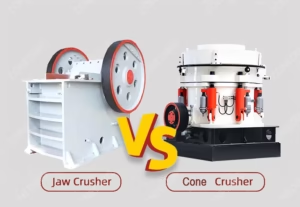
Learn mechanical and operational differences between jaw and cone crushers. Compare throughput, reduction ratio, liner wear, maintenance, and energy efficiency.
View details