 Zoneding Mining

Site Search
Search products, equipment and solution articles
整站搜索产品中心新闻中心
点击开始搜索
热门搜索
UltraForm-MXFlexiPoly-RNanoForm Z300EcoFab P200
Search products, equipment and solution articles
A spiral concentrator is a gravity separation device that uses a helical path to separate minerals based on their density. It allows heavy minerals, such as gold, iron, or chromite, to collect near the center of the spiral while lighter waste materials move to the outside. This process occurs without the use of chemicals, making it one of the most eco-friendly methods for ore concentration.
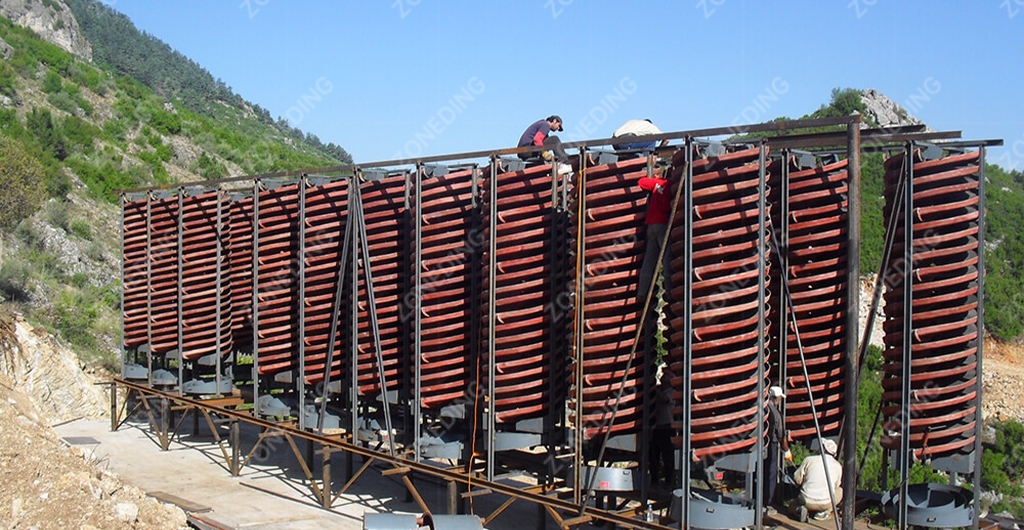
Many mining operations face high operating costs due to an over-reliance on flotation or chemical leaching. A spiral concentrator solves this issue by utilizing only water and gravity. In a typical setup, a spiral can process huge volumes of material with almost no power consumption after the initial pumping stage. ZONEDING designs these spirals to ensure a sharp transition between heavy and light minerals, which maximizes the recovery rate and significantly reduces waste.
Last Updated: May 2026 | Estimated Reading Time: 18 Minutes
A spiral concentrator works by combining centrifugal force, gravity, and hydrodynamic drag to separate particles by weight. When a mixture of water and ore (pulp) flows down the spiral, the water moves in a circular motion. This motion creates a centrifugal force that pushes the lighter, larger particles toward the outer rim of the spiral. Simultaneously, the heavier, denser particles sink to the bottom of the trough. Because these dense particles are closer to the center and experience less drag, they migrate toward the inner column of the spiral.
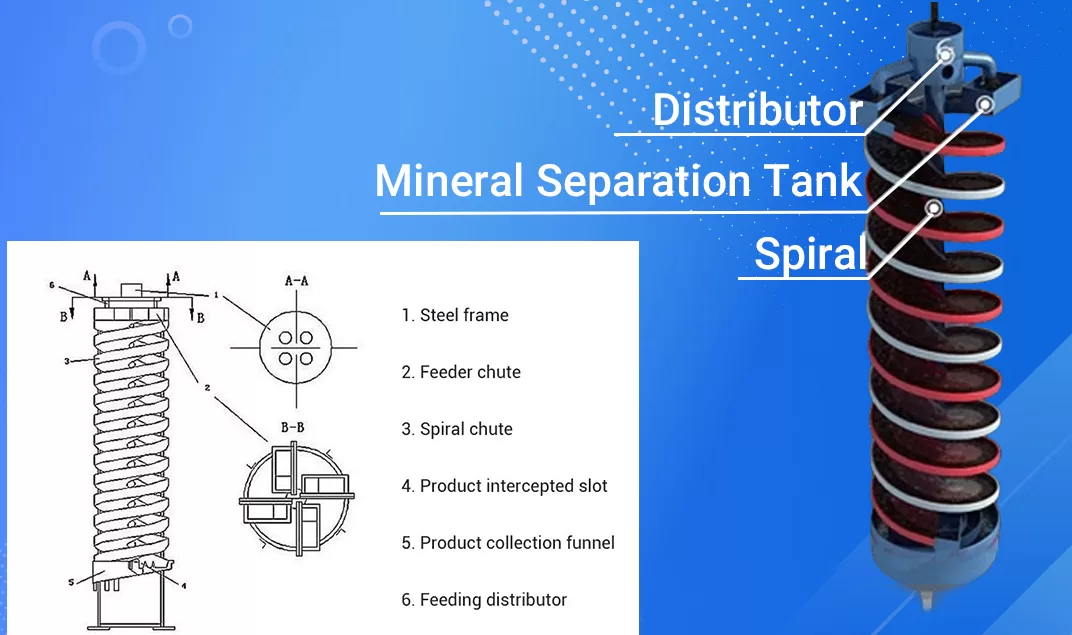
This process is similar to the physics of a centrifuge. The heavy bits stay low and move toward the center, while the light bits are forced toward the edges. ZONEDING utilizes a specific helix angle and surface profile to make this movement more efficient. This ensures that even minerals with a small density difference can be effectively separated. High-quality fiberglass or polyurethane materials are used to reduce friction. Lower friction allows heavy minerals to slide toward the center more easily, which directly increases the final concentrate grade.
Separation is not based solely on weight; it depends on how the particle interacts with the water and the spiral surface. Heavy particles possess more momentum and resist the outward push of centrifugal force better than light particles. As they slide along the bottom of the trough, they encounter higher friction. However, because they are dense, they remain in the slower-moving water layer near the surface of the spiral, allowing them to move inward.
Light particles, such as silica or clay, are pushed by the fast-moving water toward the outside. These particles stay in the upper layer of the flow. This creates a natural “sorting” effect. By the time the pulp reaches the bottom of the spiral, the heavy minerals are concentrated in a narrow band near the center. ZONEDING optimizes the spiral’s pitch to ensure the water flow remains stable. If the water flows too fast, it can wash the heavy minerals toward the outside, which ruins the recovery rate.
| Force Factor | Effect on Heavy Minerals | Effect on Light Minerals | Result |
|---|---|---|---|
| Gravity | Strong pull to the bottom | Weak pull | Heavy minerals sink |
| Centrifugal Force | Low impact | High impact | Light minerals move out |
| Friction | High at the trough surface | Low (float in water) | Heavy minerals stay inside |
| Water Velocity | Slow (near the surface) | Fast (outer rim) | Sorting by speed |
A spiral separator consists of a feed distributor, the helical trough, and adjustable discharge splitters. The feed distributor is a vital component that ensures the ore pulp is spread evenly across the entire width of the spiral. If the feed is uneven, one side of the spiral becomes overloaded. This causes the heavy minerals to be washed away by excessive water flow, which lowers overall efficiency.
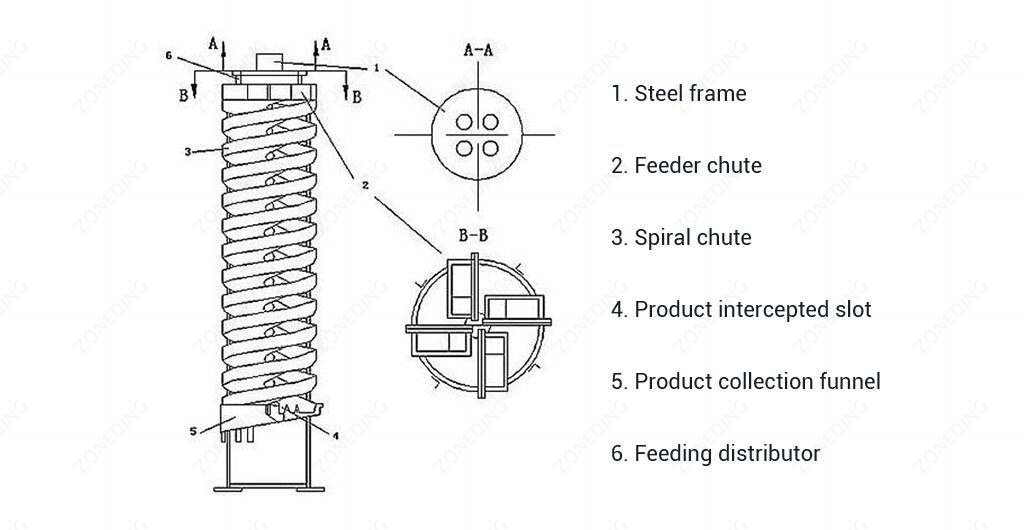
The helical trough is the primary component where separation occurs. It is a long, curving ramp that forces the material to spin as it falls. ZONEDING uses advanced molding techniques to ensure the trough is perfectly smooth. Any bump or scratch in the material can create turbulence. Turbulence disrupts the layering of minerals and mixes the heavy and light particles back together. Finally, the splitters at the bottom act as the “decision makers.” These adjustable blades cut the flowing stream into concentrate, middlings, and tailings.
| Component | Material Used | Purpose | Actual Benefit |
|---|---|---|---|
| Trough | FRP / Polyurethane | Guide the slurry | Low wear and high flow |
| Feed Box | Steel / FRP | Even distribution | Consistent recovery rates |
| Splitters | Reinforced Plastic | Separate products | Easy to tune for purity |
| Support Frame | Galvanized Steel | Hold the spirals | Stable operation, no vibration |
Low-grade plastic spirals often wear out quickly, especially when processing abrasive minerals like iron or chromite. When the surface of the spiral becomes rough, the minerals no longer slide smoothly. This creates “dead zones” where material piles up. ZONEDING uses industrial-grade polyurethane. This material is highly resistant to abrasion. It keeps the spiral smooth for several years, which means the equipment does not need frequent replacement. This significantly reduces long-term capital expenditure.
The efficiency of a spiral concentrator depends on three main factors: pulp density, feed rate, and particle size. If any of these are incorrect, the spiral will not separate the minerals properly. Pulp density is the ratio of solids to water. If the slurry is too thick, particles collide and push each other, forcing heavy minerals toward the outside. If the slurry is too thin, the water velocity becomes too high, and the heavy minerals are washed away.
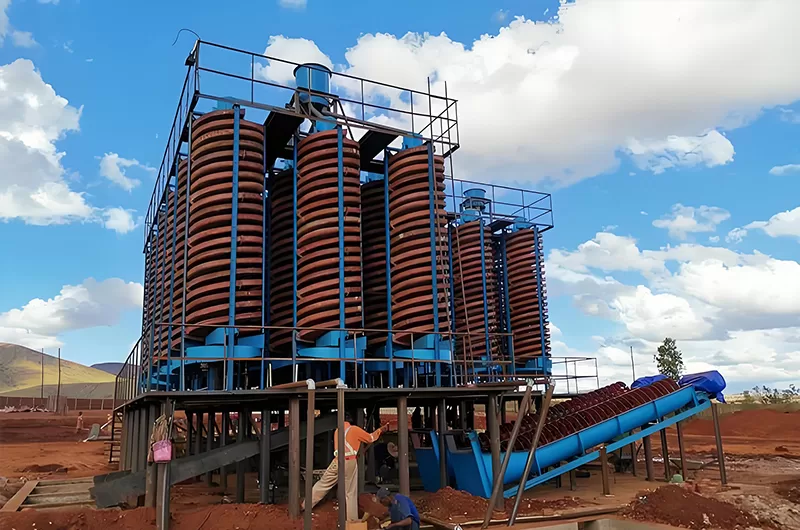
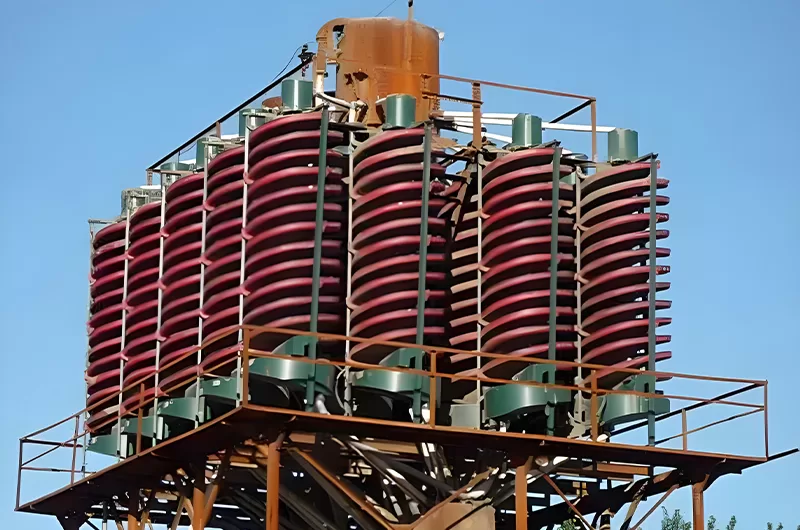
Feed rate is the amount of material entering the spiral per hour. Every spiral has an optimal operating range. If the feed rate is too high, the trough becomes overfilled. This creates a deep layer of slurry. The heavy minerals at the bottom cannot move toward the center because they are blocked by the material above them. ZONEDING engineers calculate the exact feed rate for each spiral model to ensure the material layer is thin enough for gravity to function but thick enough to maximize daily production.
Particle size is the most critical factor for gravity separation. Gravity separation works best when the particles are in a similar size range. If there is a mix of very large light particles and very small heavy particles, the large light ones might sink due to their total mass. This is known as “misplacement.”
To prevent this, a screening or grinding stage must be used before the spiral. A Ball Mill is the most effective tool for this. It breaks the ore down to a uniform size. When particles are of a similar size, density becomes the only determining factor for their movement. This allows for a recovery rate of 95% or higher. ZONEDING provides full production line designs that integrate the mill and the spiral for seamless material flow.
Spiral concentrators are used in any mining operation where a significant density difference exists between the valuable mineral and the waste. They are especially popular in “heavy mineral sands” mining for the recovery of zircon, rutile, and ilmenite. Because these minerals are much heavier than the surrounding quartz sand, a spiral can remove 90% of the waste in a single pass.
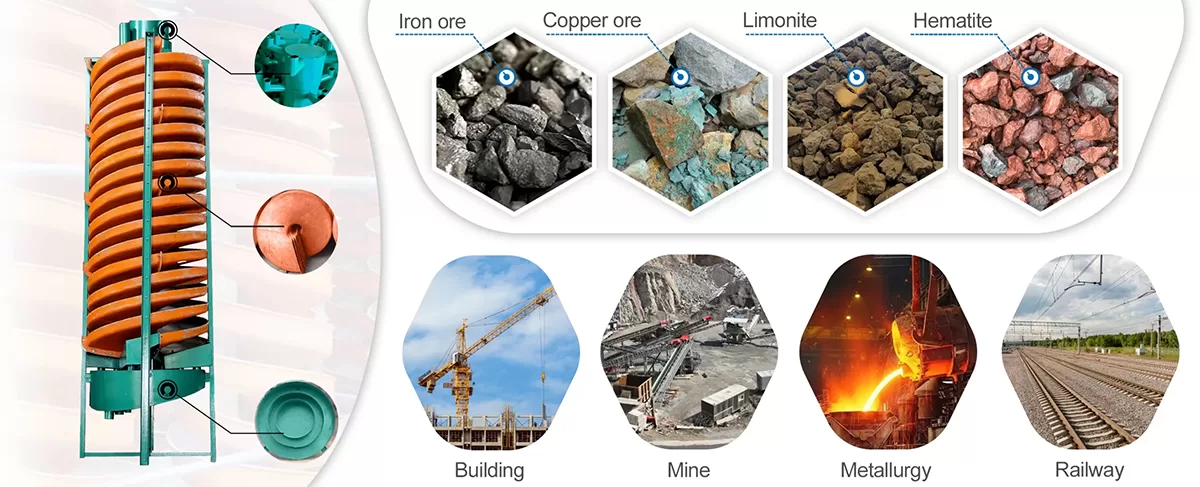
These devices are also widely utilized in iron ore processing. Siderite and hematite are much denser than the silica in which they are found. A bank of spirals can quickly upgrade low-grade iron ore into a high-grade concentrate before it enters the furnace. This saves a significant amount of energy during the smelting process. Spirals are also used in gold mining as a “pre-concentration” step. By using a spiral to remove waste before the chemical leach tank, the operation uses fewer chemicals and reduces the environmental footprint.
| Mineral | Typical Use Case | Benefit of Using Spirals |
|---|---|---|
| Gold | Pre-concentration | Reduces chemical costs |
| Iron Ore | Upgrading Hematite | Lower smelting energy |
| Zircon/Rutile | Sand Mining | High volume, low cost |
| Chromite | Tailings Recovery | Recovers lost value |
| Coal | Cleaning Coal | Removes rock and shale |
In a professional plant, a spiral is rarely used in isolation. It is part of a larger Mineral Processing Equipment circuit. The typical flow is as follows:Jaw Crusher → Ball Mill → Hydrocyclone (De-sliming) → Spiral Concentrator → Shaking Table (Final Cleaning).
By using the spiral as a “rougher,” the bulk of the waste is removed quickly. A shaking table is then used to polish the concentrate to a very high purity. This “staged” approach is the most cost-effective way to run a mine. ZONEDING specializes in designing these complete lines, ensuring the capacity of the crusher matches the capacity of the spirals to avoid production bottlenecks.
When selecting a supplier for spirals, the focus must be on the geometry and material of the trough rather than just the price. A cheap spiral with an incorrect helix angle will fail to separate minerals effectively. The purchase is essentially an investment in fluid dynamics engineering.
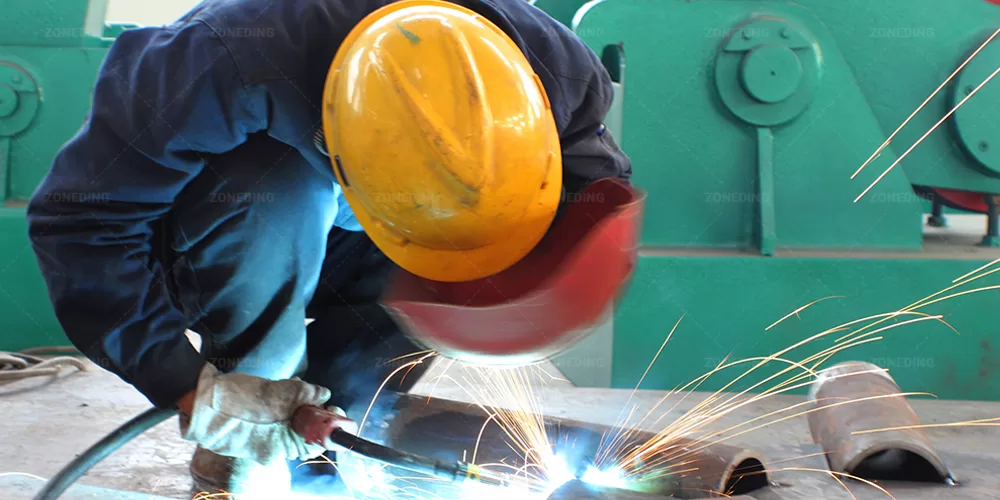
The following factors should be considered:
The industry is moving toward “Intelligent Gravity Circuits,” aiming to remove human error from the adjustment of splitters and feed rates.
Sustainability is now a primary driver in the mining industry. Because spiral concentrators use no chemicals and minimal power, they are becoming the preferred choice for new “green mining” projects. ZONEDING is investing in water-saving designs, creating closed-loop systems where tailings water is recycled back to the feed box, reducing fresh water usage by up to 90%.
Spiral concentrators are the most cost-effective method for bulk gravity separation. To achieve optimal results:
Next Step: To determine if a spiral is appropriate for a specific ore, an ore sample should be sent to ZONEDING. A professional gravity test and grind-size analysis will be performed to provide a custom recovery flow sheet and a guaranteed recovery percentage.
Last Updated: May 2026
New to mobile crushers? This guide clearly introduces their concept, key features, types, and widespread applications across various industries.
View details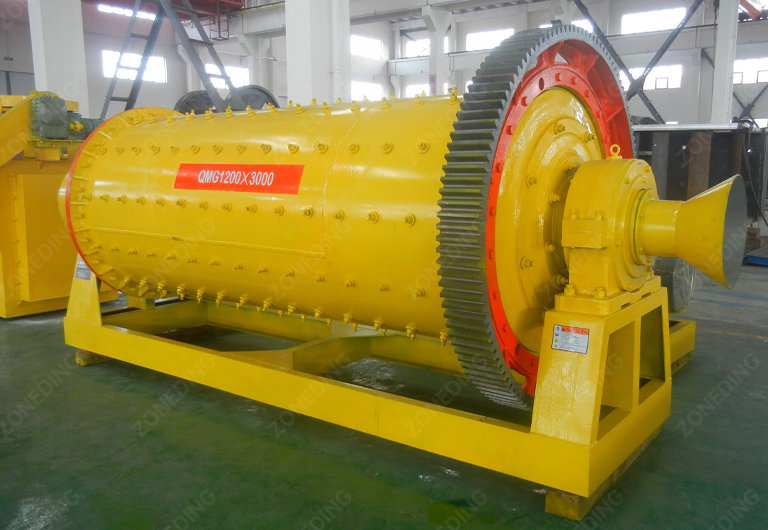
Want to boost your mill's performance? Uncover the 7 critical factors affecting grinding machine working efficiency and get actionable tips to maximize output.
View details
Learn the process of buying Crushers from China, from finding reliable suppliers to managing customs. Your all-in-one guide for sucessful imports.
View details
Build a carbon black processing plant with our expert engineering. From furnace design to automated pelletizing, we provide complete production line solutions.
View details