The discovery of a gleaming yellow speck in a pan or a quartz vein triggers an instant, primal rush of adrenaline. However, in the world of mineral exploration, “yellow” does not always equate to value. For every genuine discovery of elemental gold (Au), there are thousands of disappointments caused by iron pyrite, weathered mica, or oxidized copper. The ability to distinguish authorized currency from mere minerals is the fundamental skill upon which the entire mining industry is built.
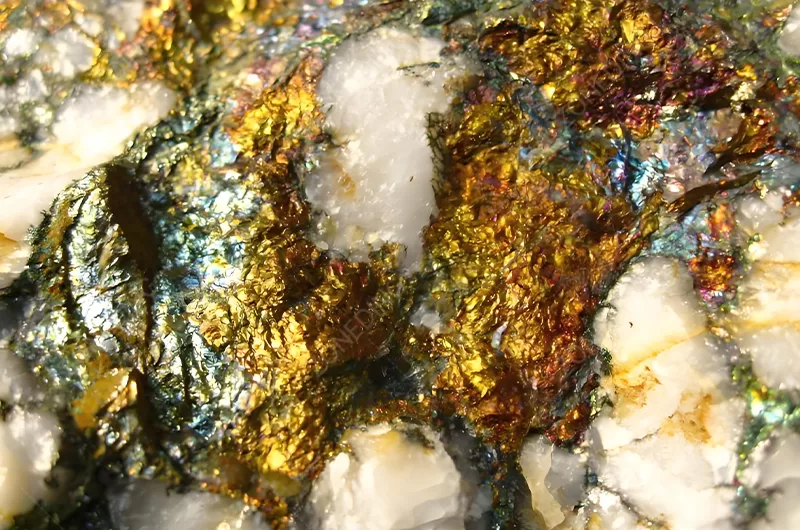
Raw gold—often referred to as native gold—rarely resembles the polished, high-karat jewelry found in a retail environment. It does not glitter aggressively; rather, it possesses a distinct, heavy glow. It is often encased in dirty rock, stained by iron oxides, or hidden beneath layers of black magnetic sand. Identifying gold in the ground requires looking beyond the superficial shine and understanding the immutable physics of the element: its extreme density, its unique malleability, and its unchangeable optical properties.
This guide serves as a technical manual for prospectors, geologists, and mining operators. It details the visual inspections and physical stress tests required to confirm the presence of gold before expensive crushing and processing equipment—such as the heavy machinery solutions provided by ZONEDING—is deployed.
Visual Properties: What Does Raw Gold Actually Look Like?
To successfully identify gold, one must first discard the Hollywood image of sparkling, diamond-like treasure. In its natural geologic state, gold is distinct but often subtle. It requires a trained eye to spot the specific “butter yellow” hue amidst the chaos of a mineral deposit.
1. The Color Spectrum and Oxidation Resistance
Pure gold maintains a rich, metallic yellow color. However, nature rarely provides 100% purity.
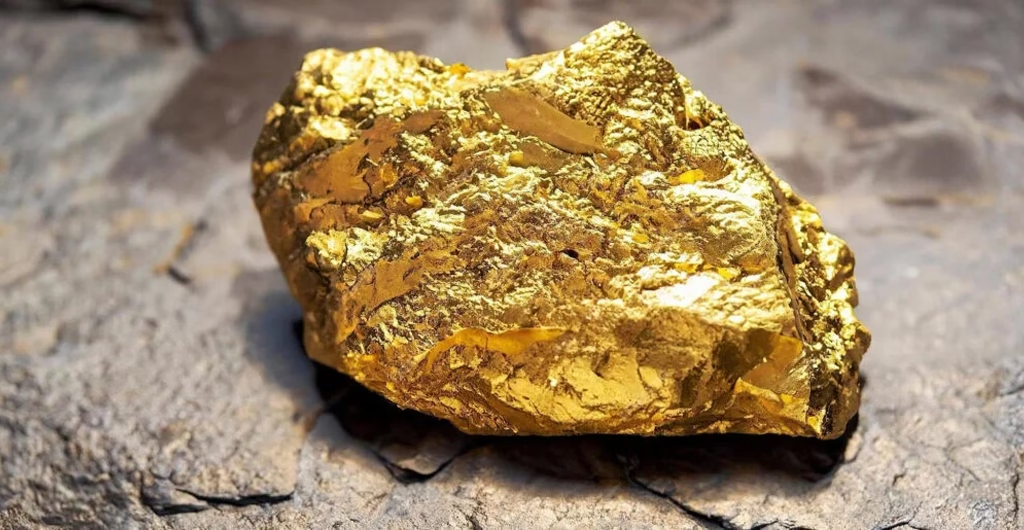
The “Butter Yellow” Standard: The classic color of raw gold is often described as resembling rich, yellow butter. It is opaque and solid.
The Silver Influence (Electrum): Gold is frequently alloyed naturally with silver. If the silver content exceeds 20%, the mineral is classified as Electrum. This creates a paler, silvery-yellow hue. Despite the lighter color, it retains the physical properties of gold.
The Copper Tint: In some deposits, copper acts as the alloying agent, giving the gold a reddish or warmer tint.
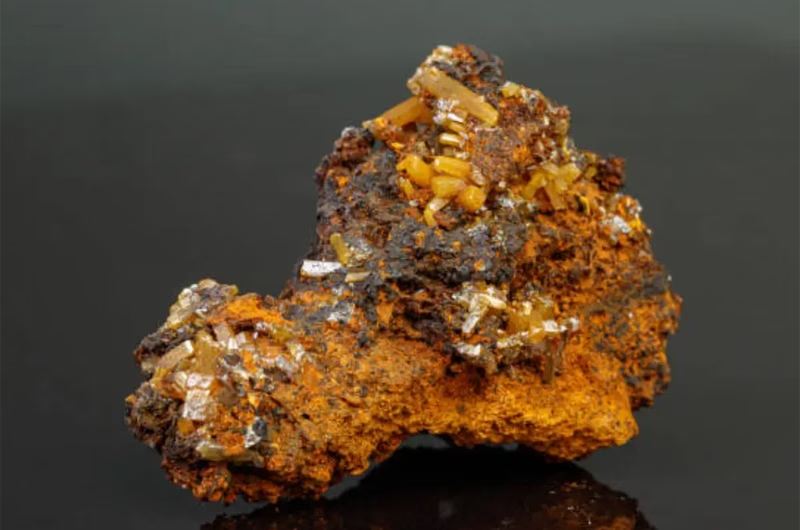
Oxidation Immunity: The most critical visual clue is consistency. Gold is a noble metal; it does not rush, tarnish, or corrode. An iron rock will turn orange (rust) over time; copper turns green (verdigris/malachite). Gold remains yellow, whether it has been exposed to air for five minutes or buried in acidic mud for five million years. If a yellow specimen appears dull, coated, or tarnished, it is highly likely to be a sulfide mineral, not gold.
2. The Luster Test: Glow vs. Glitter
This is the most reliable rapid visual test for distinguishing gold from Iron Pyrite (“Fool’s Gold”).
The Mechanism of Light: Pyrite crystals have flat, reflective faces that act like tiny mirrors. When light hits them at a specific angle, they flash brilliantly. However, if the angle changes or the light source is removed, the flash disappears instantly.
The Shadow Test: To perform this, the prospector should hold the specimen in direct sunlight and then cup their hand over it to create a shadow.
3. Crystal Habit and Shape
Gold is an isometric crystal, but visible naturally formed crystals are incredibly rare and valuable.
Placer Gold (River Deposits): This gold has traveled. Because gold is malleable (soft), the action of water, rocks, and gravel tumbling down a river acts like a hammer. Placer gold appears as flattened flakes, rounded nuggets, or worn grains. The edges are always smooth and rounded, never sharp.
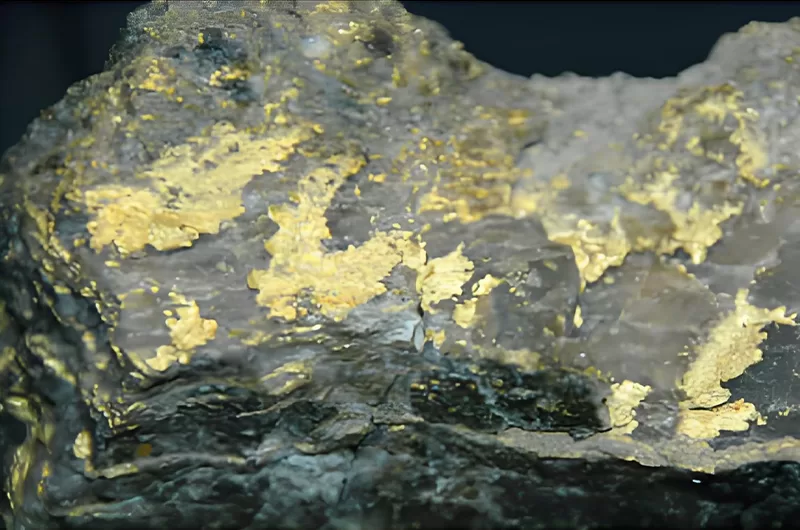
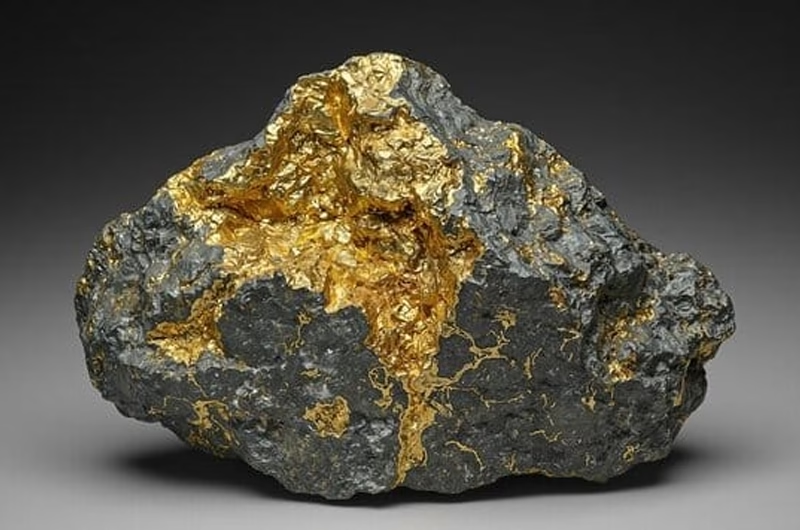
Lode Gold (Hard Rock): When embedded in quartz veins, gold has not been subjected to erosion. It often appears as irregular masses, branching “dendritic” wires, or leaf-like sheets filling the cracks of the host rock.
The Geometric Imposter: Pyrite, conversely, favors strict geometry. It typically forms perfect cubes, octahedrons, or pyritohedrons with sharp, razor-straight edges and corners. If a yellow mineral looks like a perfect manufactured cube, it is almost certainly pyrite.
The Physical Field Tests: Determining Truth Through Stress
Visual inspection is inherently subjective and capable of error. Physical manipulation provides objective data. These tests rely on the unique physical properties of Element 79 (Au) that other yellow minerals cannot mimic.
1. The Streak Test (Powder Color)
Most minerals, when pulverized, leave a powder residue color that differs from their exterior appearance. The “streak” is the true color of the mineral’s composition.
The Method: The specimen is rubbed firmly against the unglazed back of a white ceramic tile (known as a streak plate) or a piece of unweathered chert.
Pyrite Result: Despite looking yellow, Pyrite is an iron sulfide. It leaves a greenish-black or dark gray streak. This is the definitive giveaway.
Chalcopyrite Result: This copper-iron sulfide leaves a black streak.
Gold Result: Gold is a metal, not a brittle mineral. It leaves a golden-yellow streak.
Note on Softness: Because gold is soft, the streak plate might physically shave the metal rather than turning it into powder. If the mark left behind looks like a smear of yellow metal, it is gold.
2. The Hardness and Malleability Test (The Poke Test)
Gold is one of the most malleable metals on earth. It changes shape under pressure rather than breaking. Most look-alikes are brittle crystals.
The Method: Using a hardened steel pin, a needle, or the tip of a sturdy pocket knife, the user applies steady downward pressure directly onto the yellow speck.
Pyrite/Mica Reaction: These minerals are brittle. Under pressure, Pyrite will shatter, explode into dust, or crack. Mica will flake off into thin sheets. They cannot withstand deformation.
Gold Reaction: Gold behaves like cold lead or chewing gum. It will dent, flatten, or puncture. The knife point will sink into the metal without breaking it. If a grain can be sliced, smeared, or indented, it is almost certainly native gold. This property is known as “sectility.”
3. The Specific Gravity (Heft) Test
Gold is incredibly dense, with a Specific Gravity (SG) of approximately 19.3. For comparison, lead is 11.3, limestone is roughly 2.7, and Pyrite is about 5.0.
Panning Physics: This density is the precise reason why gold panning works. When a pan is agitated, gold instantly sinks to the absolute bottom and refuses to move. Even when water is sloshed strictly over it, the gold remains stationary “lagging” behind lighter sands.
The “Mica swish”: Mica is very light and flat. If the water in the pan is stirred, yellow mica flakes will swirl aggressively and float easily in the current. Gold will drop like a stone.
Manual Heft: For larger nuggets, the weight is palpable. A small nugget of gold feels surprisingly heavy for its size—a sensation often described as “deceptive weight.” Experienced miners can identify high-grade ore simply by the unusual weight of the rock in their hand.
Comparison Table: Gold vs. The Imposters
Property
Real Gold (Au)
Iron Pyrite (Fool’s Gold)
Mica / Muscovite
Chalcopyrite
Color
Golden “Butter” Yellow
Pale Brassy Yellow
White/Gold/Black
Brass Yellow with Green tint
Luster
Deep Metallic (Glows)
Mirror-like (Flashes)
Vitreous / Pearl
Metallic
Shade Test
Remains Bright
Becomes Dull/Gray
Becomes Dark
Becomes Dull
Streak
Yellow
Greenish-Black
White/Colorless
Greenish-Black
Hardness
2.5 (Soft, Dents)
6.0-6.5 (Brittle, Shatters)
2.5 (Flakes)
3.5-4.0 (Brittle)
Shape
Rounded / Irregular
Cubes / Striated faces
Flat Sheets / Platelets
Massive / Irregular
Specific Gravity
19.3 (Very Heavy)
5.0 (Moderate)
2.8 (Light)
4.2 (Moderate)
Geological Indicators: Where Does Gold Hide?
Gold is not distributed randomly across the Earth’s crust. It follows specific geological structures and rules. Understanding the host rock is often easier than finding the metal itself, serving as a roadmap to the deposit.
1. The Quartz Connection
Hydrothermal quartz veins are the primary global source of lode gold. As superheated water carrying dissolved silica and gold moves through cracks in the earth’s crust, it cools and precipitates into solid rock.
Not All Quartz is Equal: A massive vein of pure, snow-white “bull quartz” is often sterile. It solidified too quickly or lacked mineralization.
Look for “Rotten” Quartz: Geologists seek quartz that looks dirty, fractured, and ugly. Iron is gold’s traveling companion. Quartz that is stained reddish, brownish, or orange (due to oxidized iron sulfides) suggests that the vein was rich in minerals. This decayed, rusty rock is often called “gossan.”
2. Contact Zones and Faults
Gold mineralization frequently occurs at “contacts”—the precise line where two different rock types meet.
The Mechanism: For example, where a hot granite intrusion pushes against cooler sedimentary rock (like slate or limestone). The heat and pressure at these boundaries shatter the rock, creating perfect plumbing systems for gold-bearing fluids to infiltrate. Investigating the contact zone is often more fruitful than examining the center of the rock formation.
3. Black Sands (Magnetite and Hematite)
In placer mining (river and alluvial deposits), “black sand” is the primary indicator. These sands are composed of heavy iron oxides, primarily Magnetite and Hematite.
The Correlation: Because iron is heavy (SG ~5.0), it settles in the same low-pressure areas of the riverbank as gold. While iron is much lighter than gold, it acts as a marker. If a riverbed contains no black sand, the water energy is likely too high to have deposited gold.
Rule of Thumb: Follow the black sand. If a test pan yields a thick layer of black concentrate, the hydrological conditions are correct for gold deposition.
From Discovery to Ingot: Industrial Processing Solutions
Identification is merely the first step. Finding a quartz vein with visible gold is a triumph, but in hard rock mining, visible gold is essentially the tip of the iceberg. The majority of the value is usually microscopic, locked inside the sulfide or quartz matrix. It cannot be picked up by hand; it must be liberated through mechanical force.
This is where ZONEDING’s mineral processing expertise becomes critical for transforming a find into a scalable business.
Step 1: Crushing (The Liberation Phase)
To free the gold particles, the host rock must be reduced from boulders to sand.
Primary Reduction: A ZONEDING Jaw Crusher is utilized to break the mined ore chunks down to a manageable size (e.g., <100mm).
Secondary Reduction: For harder ores, a Cone Crusher is utilized. For softer or brittle ores, a Hammer Crusher is effective.
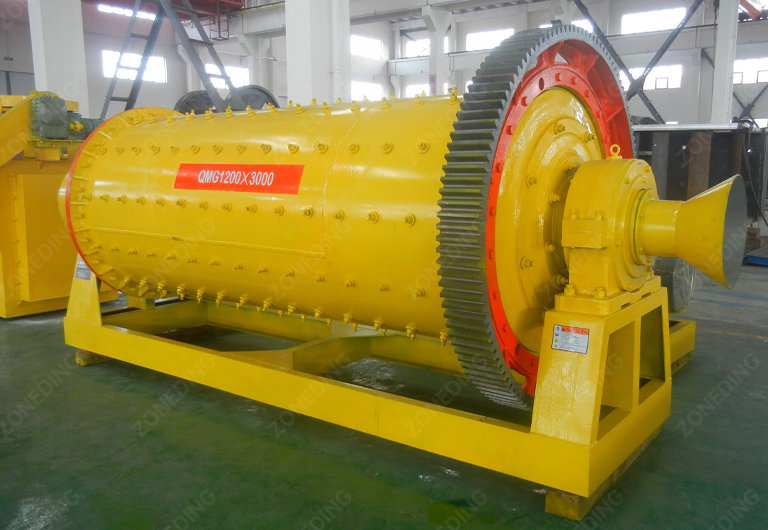
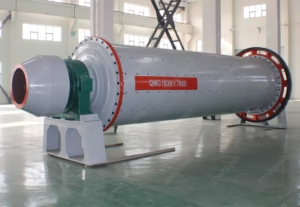
Fine Grinding: The crushed rock enters a Ball Mill. This rotating steel drum uses steel balls to grind the ore into a fine powder (slurry). ZONEDING Ball Mills are engineered to achieve the necessary “liberation size” (often 200 mesh/74 microns) to expose the gold surfaces for recovery.
Step 2: Gravity Separation (The Cleanest Method)
Because gold is nineteen times heavier than water, gravity is the most cost-effective and environmentally friendly method separation.
Shaking Tables: The slurry is fed onto a 6-S Shaking Table. The table vibrates while water washes over it. The heavy gold travels along riffles to one collection point, while the lighter quartz and waste rock wash away. This allows for immediate visual recovery of high-grade concentrate.
Centrifugal Concentrators: For fine gold recovery, a centrifugal concentrator spins the slurry at high G-force. This presses the heavy gold particles against the ribbed wall of the cone, while waste rock is flushed out. This is highly effective for “Free Milling” gold.
Step 3: Flotation (For Sulfide Ores)
When gold is associated with sulfides (like Pyrite) and is too fine for gravity separation, flotation is required.
The Process: Chemicals are added to the slurry in a Flotation Machine to make the gold-bearing sulfide particles hydrophobic (water-repelling). Air bubbles are pumped into the tank. The gold attaches to the rising bubbles and floats to the top as a mineral-rich froth, which is skimmed off for smelting.
Why Choose ZONEDING?
ZONEDING MACHINE brings over two decades of manufacturing expertise to the mineral processing sector.
Customized Solutions: Whether identifying free gold in alluvial deposits or refractory gold in hard rock, ZONEDING engineers design the workflow (Gravity vs. Flotation) to match the unique ore characteristics.
One-Stop Shopping: ZONEDING offers the full line of equipment, from the initial feeder to the final dryer, ensuring compatibility and streamlined maintenance.
Global Reach: With equipment operating in major gold-producing regions—from the Australian outback to South Africa and South America—ZONEDING understands the logistics and durability required for remote mining operations.
2025 Trends in Gold Identification Technology
While the hammer and loop remain essential tools, technology is reducing the guesswork in exploration.
Handheld XRF Analyzers:X-Ray Fluorescence (XRF) guns are becoming standard equipment for field geologists. By simply pointing the device at a rock face, the operator receives an immediate elemental analysis on a digital screen. While these units are a significant investment, they scientifically confirm the chemical presence of gold (Au) and pathfinder elements (like Arsenic or Silver) without destroying the sample.
Electronic Assaying and ZVT:New metal detection technology, such as Zero Voltage Transmission (ZVT), allows detectors to “ignore” the heavy mineralization of hot ground (iron-rich soil) and detect gold nuggets at significantly greater depths than traditional VLF or Pulse Induction machines.
FAQ: Common Questions on Identifying Gold
Q1: Does real gold float on water?
No. This is a common myth. In a physical sense, gold is extremely dense and will sink immediately. If a golden flake floats on the surface tension of water in a pan, it is almost certainly Mica or a thin flake of “Fool’s Gold.” Surface tension can only support materials with low density and high surface area.
Q2: Can gold appear silver or white?
Yes. Natural gold is rarely pure; it is an alloy. If the silver content is naturally high (usually over 20%), the result is Electrum, which has a pale, silvery-yellow color. In some rare instances, gold can be coated in mercury (from old mining operations) or manganese, hiding its color. However, it will still pass the specific gravity and malleability tests.
Q3: Is “Fool’s Gold” (Pyrite) always worthless?
Not always. In many large-scale professional mines, the visible gold is non-existent. Instead, microscopic gold particles are trapped inside the crystal lattice of the Pyrite. This is known as “refractory gold.” In these cases, the Pyrite is harvested and concentrated, and the gold is extracted chemically (often via roasting or cyanidation). Therefore, large deposits of gold-bearing Pyrite should be assayed, not ignored.
Conclusion
The ability to identify gold in the ground is a discipline that combines geological knowledge, physical testing, and careful observation. It requires the prospector to look past the superficial glitter of sulphides to find the heavy, malleable, and consistent glow of true currency.
Check the Shade: Does it stay bright when the sun is blocked?
Check the Streak: Is the powder yellow, not black?
Check the Hardness: Does it dent like lead, rather than shatter like glass?
Once the presence of gold is confirmed, the challenge shifts from exploration to extraction. The profitability of a mine relies not just on the grade of the ore, but on how efficiently the precious metal can be separated from the waste rock.
ZONEDING provides the complete range of infrastructure required to turn a geological discovery into a commercial reality. From heavy-duty Jaw Crushers that fracture the quartz to precision Shaking Tables that capture the finest dust, ZONEDING equips miners with the tools needed to maximize recovery rates.
Contact ZONEDING today to discuss ore testing and processing plant design.
From panning to separation, get ultimate guide on how to process black sand for gold. Learn tips to improve yield and identify gold-rich black sand deposits.
This blog tells what a concrete crusher is, its work principle, and the purpose, process, and benefits in turning construction waste into valuable resources.
Want to boost your mill's performance? Uncover the 7 critical factors affecting grinding machine working efficiency and get actionable tips to maximize output.
Discover 9 most common problems on ball mill, from excessive wear to power consumption. Learn how to identify issues and implement solutions to extend lifespan.
 Zoneding Mining