If you are in the aggregate business, you know a simple economic truth: Clean stone prints money; dirty stone loses contracts.
In 2025, the construction industry demands higher standards than ever before. Concrete producers now reject sand with more than 3% silt content. If your crusher run is full of clay, dust, and impurities, you are selling a low-value commodity. You are leaving profit on the table.
The solution is a Stone Washing Machine. But this is not just a tub of water. It is a piece of precision engineering designed to separate, clean, and dewater. The market offers various types—Wheel, Spiral, Log—and choosing the wrong one can lead to bottlenecks or wasted energy.
A Stone Washing Machine, also known as an Aggregate Washer or Sand Washer, is an essential piece of equipment in the wet processing line. Its primary job is simple: remove impurities.
When you crush stone, you create dust. When you mine river gravel, you dig up mud and organic debris. A washing machine uses water, friction, and gravity to separate these unwanted light particles (clay, silt, dust) from the valuable heavy aggregates (sand, gravel).
Think of it as a massive, industrial washing machine for rocks. It takes in dirty, low-grade feed and outputs clean, construction-grade material ready for high-strength concrete or asphalt.
Why Do We Need the Stone Washing Machine?
You might ask, “Can I just dry screen my material?” In the past, maybe. Today, washing is often mandatory for three reasons.
1. Increasing Market Value
Raw, dirty sand might sell for $5 per ton. That same material, washed and graded, can sell for $15 to $20 per ton. The machine acts as a value multiplier. It transforms waste into premium product.
2. Meeting Construction Standards (ASTM/EN)
Modern infrastructure—bridges, skyscrapers, dams—uses high-performance concrete.
The Enemy is Clay: Clay swells when wet and shrinks when dry. If clay is left in the sand, the concrete will crack.
The Enemy is Dust: Excessive stone dust absorbs water, weakening the cement bond.
A stone washing machine ensures your product passes strict laboratory tests for cleanliness.
3. Environmental Compliance
Dry screening creates massive dust clouds. In many regions, strict environmental laws prohibit dry processing near residential areas. Wet washing naturally suppresses dust, keeping your site compliant and your neighbors happy.
What Are the Main Types of Stone Washing Equipment?
Not all washers are created equal. The two dominators of the market are the Wheel Bucket Washer and the Spiral Sand Washer. Understanding the difference is critical to your ROI.
What is the Wheel Sand Washer?
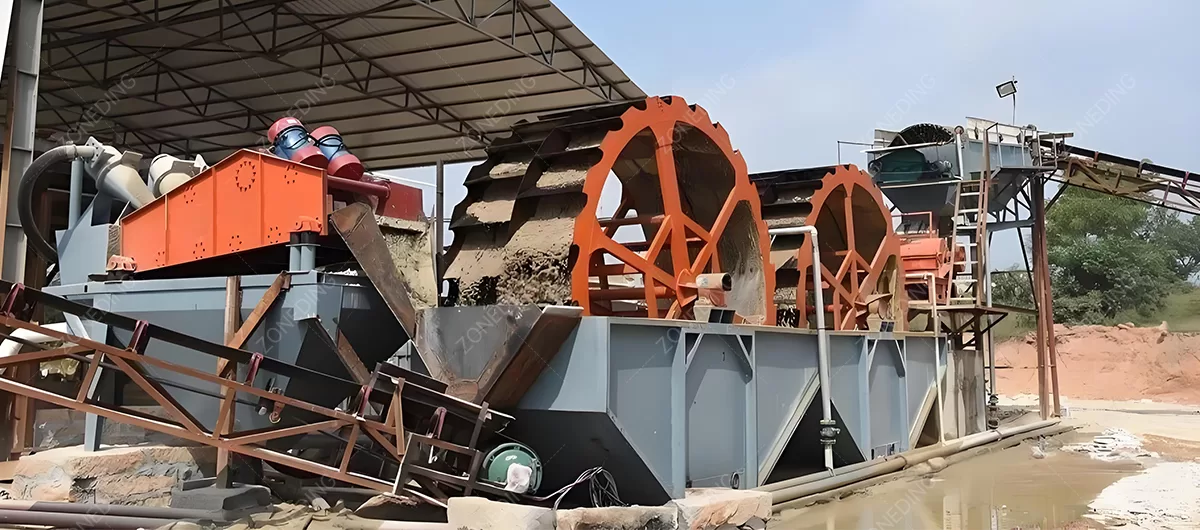
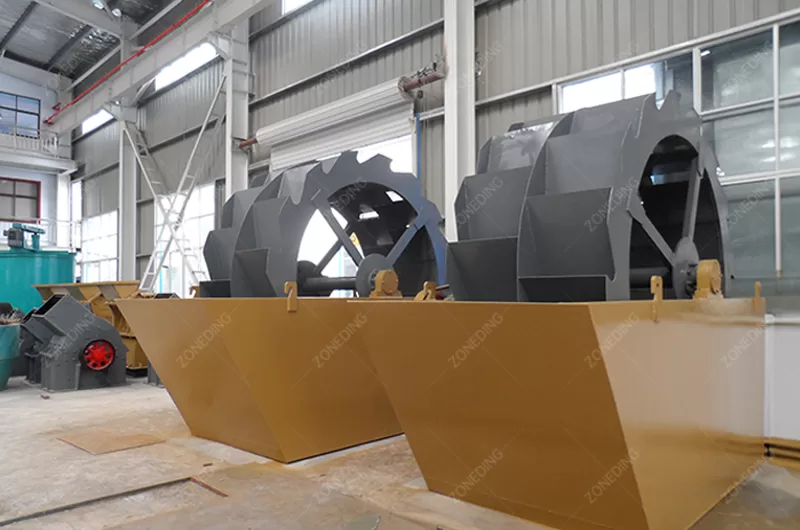
The Wheel bucket washer is the most popular choice for sand making plants.
The Mechanism: It looks like a water wheel. The buckets rotate slowly in a tank of water. Material is fed into the tank. The slow rotation agitates the sand, separating the dust. As the wheel lifts, the buckets scoop up the clean sand, while the water drains back through the mesh.
The Benefit: It is simple, energy-efficient, and has a small footprint. Crucially, it causes very little loss of fine sand.
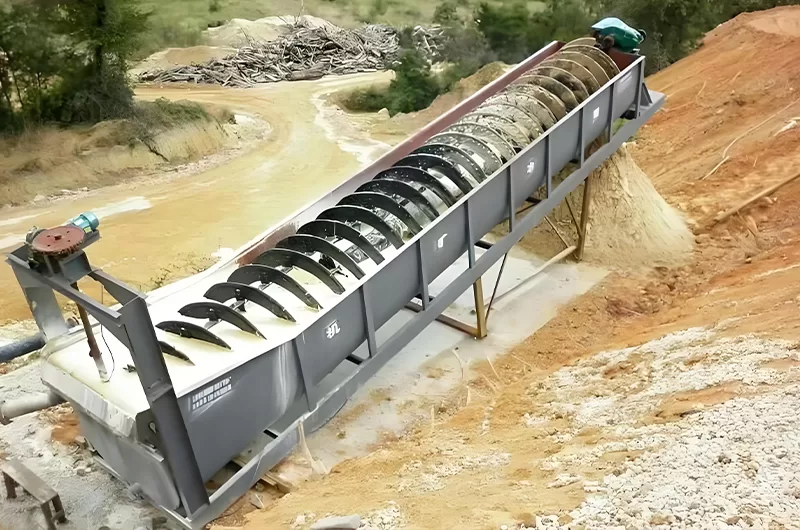
The Mechanism: It features a long, inclined trough with a rotating screw inside. The screw acts like a scrub brush, grinding sand particles against each other to remove sticky impurities. The heavy sand is pushed up the slope to discharge, while the lighter clay floats away at the bottom.
The Benefit: It has higher cleaning power. It is excellent for materials with sticky clay that needs to be scrubbed off.
What are Their Differences?
Here is a quick comparison to help you decide.
Feature
Wheel Washer
Spiral Washer
Cleaning Concept
Gentle rinsing & Agitation
Strong Scrubbing & Friction
Fine Sand Retention
High (Good for fines)
Medium (Can lose fines in overflow)
Water Consumption
Lower
Higher
Structure
Compact, Vertical
Long, Linear
Ideal Material
Crushed Sand (Man-made)
River Sand / Clay-rich Sand
Maintenance
Low (Bearings isolated from water)
Medium (Liner wear)
Price
More Affordable
Higher Investment
What Does a Complete Stone Washing Plant Flow Chart Look Like?
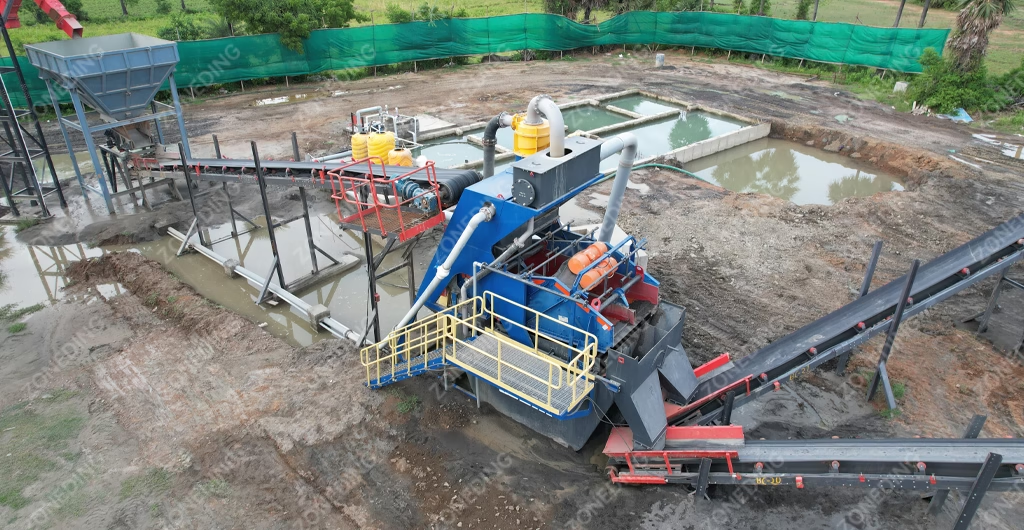
A washing machine does not work alone. It is part of a system. To get the best results, you need a complete aggregate washing plant layout. Here is the standard flow ZONEDING designs for clients:
Feeding & Screening: The raw material goes through a Vibrating Screen. Large stones are separated. Only the material under 5mm (or 10mm) falls through to the washing circuit.
Primary Washing: The material enters the Stone Washing Machine. The main cleaning happens here. Mud flows out the weir; sand moves forward.
Fines Recovery (The Profit Booster): The dirty water overflowing from the washer still contains valuable fine sand (0.16mm – 3mm). We pump this “waste” water into a Hydrocyclone. It captures 90% of this fine sand and returns it to the product pile.
Dewatering: The washed sand is wet (20-25% water). It lands on a Dewatering Screen. Vibration shakes the water out, reducing moisture to 12-15%.
Stockpiling: The conveyor belt takes the finished product to the pile. It is now ready for sale.
What is the Price of Stone Washing Machine?
This is the question every buyer asks. Why does one supplier quote $8,000 and another quote $25,000 for a machine with the same capacity?
The price depends on three factors: Durability, Efficiency, and Accessories.
Steel Thickness: Cheap machines use thin metal sheets. Sand is abrasive. A thin tank will wear through in 18 months. ZONEDING uses heavy-gauge steel plate and anti-corrosion marine paint. You pay for a 10-year lifespan.
Drive Assembly: The motor and gearbox are the heart of the machine.
Budget: Unknown motor brands, generic gearboxes that leak oil.
ZONEDING Standard: We use high-efficiency motors and hardened-face gearboxes. They cost more upfront but save you thousands in avoided downtime.
The Protection: Does the price include polyurethane (PU) liners or high-manganese mesh? These protect the machine from wear. Cheap quotes often leave these out.
Estimated Price Ranges (2025 Market):
Small Wheel Washer (20-50 TPH): $5,000 – $12,000
Large Wheel Washer (150-200 TPH): $25,000 – $45,000
Spiral Washer (Double Screw): $15,000 – $55,000
How to Choose the Right Stone Washing Machine?
Don’t guess. Use this checklist to select the right model.
1. Analyze Your Raw Material
Clean Crushed Rock: Use a Wheel Washer.
River Sand with Silt: Use a Wheel Washer + Fines Recovery.
Dirty Gravel with Sticky Clay: Use a Spiral Washer or even a Log Washer machine for heavy scrubbing.
2. Output Requirement (TPH)
If you need 100 TPH, buy a machine rated for 120 TPH.
Never run a washer at 100% max capacity constantly. It increases wear and lowers cleaning efficiency.
3. Grain Size
If you need to retain very fine sand (for plastering), choose a machine with a lower overflow speed (Wheel type) to prevent washing the good sand away.
How to Manage Water Consumption and Sludge Treatment Efficiently?
Water management is the biggest operational challenge. A washing plant uses a lot of water. You cannot simply dump muddy water into a river.
The Zero-Discharge Solution
ZONEDING designs closed-loop systems.
Sedimentation Pond: The dirty water flows into a pond. Heavy sludge sinks. Clean water stays on top and is pumped back to the washer.
Thickener Tank: For limited space, use a Deep Cone Thickener. It uses chemical flocculants to settle the mud instantly.
Filter Press: This machine squeezes the thick sludge into dry “filter cakes” (solid mud blocks). You can use these for landfill or brick making. The clear water is recycled.
What Wear Parts Require Regular Maintenance and Inspection?
To keep your machine running for years, you must watch the wear parts.
Screen Mesh (Wheel Type): This holds the sand. Check for holes weekly. If there is a hole, you are losing money (sand) back into the pond. ZONEDING offers durable PU mesh that lasts 3x longer than steel.
Impeller/Screw Liners: These take the friction. On spiral washers, checking the cast iron shoes is vital. Replace them before the wear reaches the main shaft.
Bearings: This is critical.
Wheel Washer: The ZONEDING design isolates the bearing from water. It rarely fails if greased.
Spiral Washer: The lower submerged bearing is the weak point. Check the seals monthly.
V-Belts: Check tension monthly. Loose belts mean the machine runs slower, reducing your tons per hour.
Ready to Customize Your Aggregate Washing Plant with ZONEDING?
You don’t just need a machine; you need a solution that fits your quarry’s geology and your budget.
At ZONEDING, we don’t believe in “one size fits all.”
We Test: Send us your sample. We analyze the clay content.
We Design: We draw the flow chart, including pumps, conveyors, and recycling systems.
We Build: From our factory in China directly to your site, removing the middleman markup.
Whether you are removing clay from limestone or processing silica sand, we have the technology to increase your profit margin.
Contact us today to discuss your project and get a customized quote.
FAQ
Q1: Can a stone washing machine remove heavy plastic and wood?
Standard washers remove light dust and soluble clay. For floating debris like wood or plastic roots, the Spiral Washer is better because the floating debris overflows easier. For heavy contamination, you may need a specialized “Trash Screen” before the washer.
Q2: What is the difference between a Silica Sand Washing Process and standard construction sand washing?
Silica sand (for glass) requires extremely high purity (low iron). This process is more complex. It often involves scrubbing (attrition cells), magnetic separation, and acid leaching, in addition to standard washing. ZONEDING can design these high-end lines.
Q3: Does the washing machine crush the stone?
No. It only separates. However, a Log Washer provides very aggressive attrition that can break up soft, friable stones or clay balls, which might look like crushing, but the hard stone remains intact.
Q4: Can I use seawater for washing?
Generally, no. Seawater contains salt (chloride), which corrodes the steel reinforcement in concrete. If you wash with seawater, the sand cannot be used for reinforced concrete construction. You must use fresh water.
Q5: How do I choose between a single screw and double screw washer?
It depends on capacity. A single screw might handle 40-60 TPH. A double screw can handle 100-200 TPH. The double screw also provides a wider settling area, which can be slightly better for retaining fines.
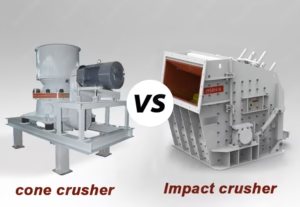
Learn Differences between impact crushers and cone crushers. Know their distinct benefits, limitations, and applications to make choice for aggregate Plant.
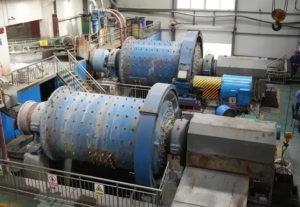
This guide tells steps for tungsten ore processing like crushing, grinding, gravity separation, flotation, magnetic separation to produce tungsten concentrate.
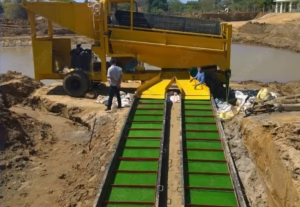
Explore placer gold processing methods, from traditional gravity concentration to separation technologies. Learn to optimize mineral processing machines setup.
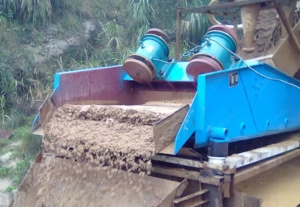
This guide tells 5 critical factors for selecting right dewatering screen. Learn to evaluate feed tonnage, particle size, desired moisture content, and more.
 Zoneding Mining